A Short History of the US Military: The Berlin Airlift
US airlift aircrews brought life-saving food, fuel, and other supplies to Berlin.
By: Dave Patterson | September 2, 2025 | 954 Words
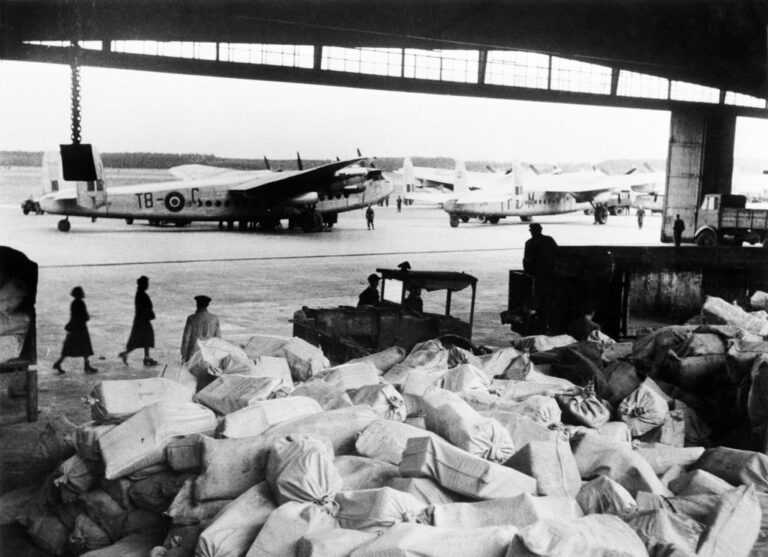
(Photo by Daily Mirror/Daily Mirror/Mirrorpix via Getty Images)
The Berlin Airlift is one of the most significant military operations in history, noted for its logistics prowess and life-saving results. When World War II concluded in May 1945, the loser, Germany, was divided into four zones of occupation. West Germany was managed by the Allied powers – the United States, Great Britain, and France – and East Germany was controlled by the Soviet Union. Berlin, the former German capital, was isolated in East Germany, surrounded by the Soviet Zone.
The Soviet Union Prompted the Berlin Airlift
Berlin, too, was divided into similar regions of control. But tensions grew when the Deutschmark currency was introduced in the western zones of Germany and Berlin to bring stability to the economy. Moscow took significant exception because it had introduced its own money. The Kremlin wanted to gain greater economic control over its zone and diminish Western influence.
The Soviet Union viewed the Deutschmark as a challenge to its authority and control in eastern Germany and reacted by cutting off all road, rail, and canal access to West Berlin. This action stranded the American, British, and French zones, leaving them without coal, food, and essential supplies. The Soviets intended to compel the West to abandon Berlin and strengthen its hold on the city. The 2.5 million residents living in West Berlin were facing starvation and freezing temperatures in the winter. The only transportation options were three 20-mile-wide air corridors that had been agreed to in writing.

(Photo by Daily Mirror/Daily Mirror/Mirrorpix via Getty Images)
To address the problem, the United States and Britain decided that an airlift operation to move essential supplies from West Germany to West Berlin was the answer. As the US State Department, Office of the Historian recounted, “The United States launched ‘Operation Vittles’ on June 26, with the United Kingdom following suit two days later with ‘Operation Plain Fare.’” At the beginning of the operations, there were few cargo aircraft available to take on this enormous task. At the time, the Americans and Brits estimated it would take 1,534 tons of foodstuffs a day to keep more than 2 million people alive. That number did not include coal and fuel. The total needed ended up being 3,475 tons daily. When the airlift started, there were only 102 two-engine C-47s, each capable of carrying 3.5 tons, and two Douglas C-54 Skymasters, with a hauling capacity of ten tons – a meager start.
The United States and Britain embarked on a bold initiative to launch an airlift operation to Berlin, supplying the residents of West Berlin with supplies needed to survive. The US National Security Council (NSC) worried that there would be danger from Soviet forces that would attempt to interrupt the airlift flow. A declassified NSC document dated Oct. 6, 1948, explained, “It is assumed that the problem envisages interruption of the airlift as a result of varying forms of physical interference by the Russians with the movement of US planes into or out of Berlin.” Though no overt hostile action by the Russians resulted in loss of aircraft or crew, episodes of Soviet aircraft buzzing the airlifters were common. Harassment included radio jamming and searchlights trying to blind airlift pilots flying the corridors.
 When the airlift began, there were only two airfields in Berlin: Tempelhof and Gatow. On Aug. 5, 1948, American, French, and German volunteers in the French sector of Berlin broke ground for Tegel Airfield, which was up and running in three months. With three airfields, the flow became extremely efficient. Planes landed every three minutes, offloaded the cargo, and were airborne again in less than 30 minutes. At Tempelhof Airport, “At the height of the campaign, one plane landed every 45 seconds,” the State Department History reported. According to the Berlin Airlift Historical Foundation, a hallmark human-interest story of the Berlin Airlift was about the exploits of the candy bomber, Air Force First Lt. Gail Seymour Halvorsen, who dropped sweets suspended under small parachutes to children standing at the end of the Berlin runways. “Every day, the number of children would increase, and he made several more drops.”
Defeating the Soviet Blockade Was Successful
The Berlin Airlift was successful. After 13 months of Soviets blockading the transportation routes into Berlin, Moscow called it quits. According to the State Department Historian, “On May 11, 1949, Moscow lifted the blockade of West Berlin. The Berlin Crisis of 1948-1949 solidified the division of Europe. Shortly before the end of the blockade, the Western Allies created the North Atlantic Treaty Organization (NATO).” West Germany was established soon after.
Courageous airmen flying narrow air corridors, braving terrible weather and Soviet harassment, delivered life-saving cargo. The statistics are impressive. When the airlift ended in September 1949, “In total, the US delivered 1,783,572.7 tons, while 541,936.9 tons were delivered by the British, totaling 2.3 million tons from 277,569 total flights to Berlin. C-47s and C-54s alone traveled over 92 million miles in order to do so,” the Berlin Airlift Historical Foundation confirmed. Confronted with enormous odds, Americans and their like-minded allies summoned the resilience and fortitude to overcome the Soviet resistance.
The views expressed are those of the author and not of any other affiliate.

- The Berlin Airlift is one of the most significant military operations in history, noted for its logistics prowess and life-saving results.
- A disgruntled Soviet Union wanted to solidify its control of eastern Germany and reacted by cutting off all road, rail, and canal access to West Berlin, stranding people without food and other necessities in the Allied regions.
- Emblematic of the brave efforts to keep 2 million residents fed, Air Force First Lt. Gail Seymour Halvorsen, know as the candy bomber, dropped sweets suspended under small parachutes to children standing at the end of the Berlin runways.
Test Your Knowledge – Take the Quiz