Aramaic – From Ancient Empires to the Modern Age
After thousands of years, this language is still spoken in some places today.
By: James Fite | June 2, 2026 | 664 Words
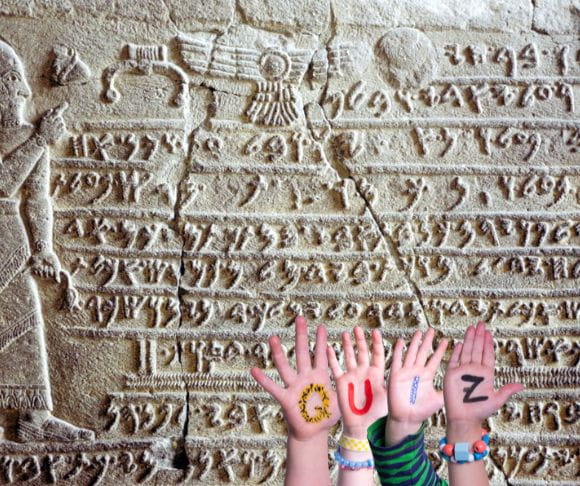
(Photo by CM Dixon/Print Collector/Getty Images)
If Sumerian was the language of the first civilizations and Akkadian of the first empire, then Aramaic can best be described as the first worldwide language. It may not get quite the same amount of attention as Greek or Latin – two later worldwide languages – but it spread just as quickly and nearly as far.
The First True Lingua Franca
Aramaic first emerged as its own language in the late 11th century BC, about 3,000 years ago, among the Aramaeans of the Middle East. Within a century or two, inscriptions in Aramaic began appearing all over the Near East. Eventually, the language spread as far west as Syria and Upper Egypt, spanning all the way across Iran and to India in the East and up to modern-day Turkey in the North.
As people moved, fought, and traded, they took their languages with them. So how did Aramaic end up replacing the other dominant languages? For one, its writing system was simpler. Before around 1,000 BC, the ancient and now-dead language Phoenician was written using Cuneiform, as most languages at the time were. The region, however, was ruled by Egypt, which had its own language and writing system. Eventually, the ancient Cuneiform and the Egyptian hieroglyphs were together refined into the Phoenician alphabet. It had more rules than other languages, and it was easier to learn. Cuneiform had anywhere from 600 to 900 signs in regular use, depending on the region. There were more than 700 characters in Egyptian hieroglyphs at the time. Phoenician had but 22 – and they mostly represented independent consonant sounds.
Though the Phoenician language died out, its alphabet was adopted and adapted for the then-spreading language of Aramaic – and, eventually, Greek, Old Italic, Hebrew, and some Anatolian scripts.
Imperial Aramaic – Linguistic Glue of an Empire
Merchants used Aramaic with the adapted Phoenician alphabet. Officials both secular and religious used it. By the seventh and sixth centuries BC, Aramaic had almost entirely replaced Akkadian as the common language of the region. Then came the Achaemenid Persian Empire. The Persians adopted Aramaic as their administrative language, and historians often call that form Imperial Aramaic.
 Like English today, Aramaic then became the simplest way to communicate in a shared language across the known world. In fact, Aramaic is still spoken by hundreds of thousands of people in some form or another today. Approximately half a million people, mostly in Assyrian communities across Iraq, Iran, and Syria, speak Assyrian Neo-Aramaic (or Suret). Another 240,000 or so, mostly in Iraq, speak Chaldean Neo-Aramaic. Perhaps as many as a quarter-million belonging to the Syriac Orthodox community in Turkey speak Turoyo, another dialect of Aramaic. Finally, Western Neo-Aramaic is the modern dialect most closely related to the old Aramaic spoken by Jesus. It’s critically endangered, with only somewhere between 5,000 and 18,000 speakers in a few remote mountain villages in Syria, but it’s hanging on.
But, like all other languages throughout history, it didn’t remain on top. From 334 to 323 BC, Alexander the Great conquered the Persian Empire, Egypt, Mesopotamia, the Levant, Asia Minor (modern Turkey), and even reached into India. And where Alexander went, he took Greek with him. As well, by the seventh century AD or so, the Arab conquests saw the expansion of the Islamic empire and the spread of Arabic, a closely related Semitic language. Aramaic, though it still holds on in some places, was eventually replaced almost entirely by its Semitic cousins, Hebrew and Arabic, as well as Greek, which adopted the Phoenician script despite being in an entirely different language family.
Next up on our linguistic journey through time, we’ll backtrack a bit and examine Egyptian – another ancient language that lives on in modern dialects.

- Aramaic was a simpler language than Akkadian or Sumerian, and it adopted a Phoenician alphabet that was far easier to manage than Cuneiform.
- The spread of Aramaic really took off when the Persians adopted it as the administrative language of their empire.
- Aramaic was eventually replaced by Greek, Hebrew, and Arabic, mostly through conquest.