Sumerian – The First Written Language
The invention of writing was flashpoint in human civilization.
By: James Fite | May 13, 2026 | 669 Words
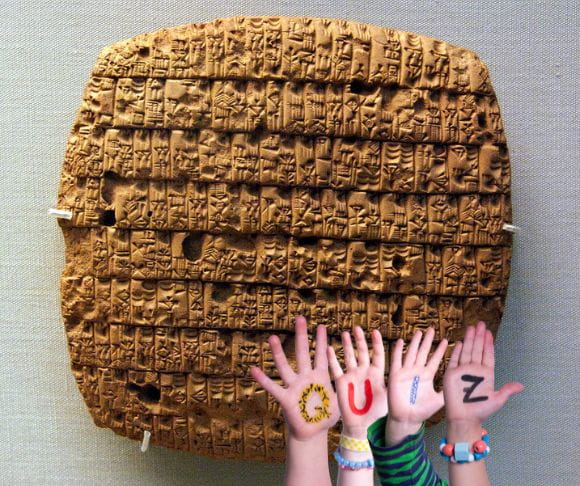
(Photo by Prisma/Universal Images Group via Getty Images)
What was the first language? The answer to that question is difficult at best and perhaps impossible at worst. But historians have some good guesses. We simply can’t know or really describe any spoken language before writing started – no one remains to explain it, and they didn’t leave any records. But the oldest known written language is Sumerian, produced by the earliest known civilization, Sumer, in early Mesopotamia. Today that area, located between the Tigris and Euphrates rivers, is part of southern Iraq.
Sumerian died off millennia ago and left no linguistic descendants. However, the writing system it used, cuneiform, survived through several other ancient and now long-dead languages, even bridging the gap into the Semitic language family, to which modern Hebrew and Arabic belong. So how did humanity go from the language isolate Sumerian and cuneiform script to modern Hebrew and Arabic with alphabets? It’s a long and winding journey through early human history; let’s start at the beginning.
The Origins of Writing – Keeping Count
Aisling Serrant of the Museum of London Docklands explained the modern best guess at when the very first examples of writing occurred in a post for DigVentures. While many theories exist for when writing began, it can probably be traced back to farmers in the ninth millennium BC, between 10,000 and 12,000 years ago and the first full millennium of the current Holocene epoch. As Aisling noted, ancient coin-shaped clay tokens have been found that were carved with certain symbols and used as counting devices dating back to this time. A disk bearing a cross, for example, could account for a single sheep. In this way, the earliest agricultural records could be kept.
By the fourth millennium (4,000 BC to 3,001 BC), these tokens were replaced with slightly more complex clay bullae (Latin for bubble), which, as trade developed, were eventually replaced by flat clay tablets. Over time, the system continued to expand but be simplified to show different meanings. By 3,000 BC, the markings not only represented the object but also the sound of the word used to describe it. Such markings were developed to represent more complex and abstract ideas of a growing civilization, such as records of battles, directions, payments, and so on. And like that, the first written languages and writing systems were born.
From Sumerian to Akkadian – More Merger Than Replacement
The oldest known example of a full written language, Sumerian, developed around 3,400 BC, more than 5,000 years ago. As a language isolate, Sumerian has no known ancestral or linguistic relatives. It appeared in southern Mesopotamia and eventually died there without spreading very far. Because it appeared suddenly in written form without a clear precursor, scholars often refer to its origin as the “Sumerian Problem.”
 Whatever its origin, however, the language’s demise is now much better understood. By about 2,000 BC (about 4,000 years ago), Sumerian was replaced as a spoken language by Akkadian, the oldest known member of the Semitic language family. It, too, originated in Mesopotamia, though to the north and considerably later (around 2,500 BC). Eventually the Akkadian civilization conquered Sumer under Sargon the Great. While Sumerians built the first cities, Akkadians built the first empire.
Despite conquering the Sumerians, Akkadians adopted much of their culture and writing. The languages merged over time, with Akkadian replacing spoken Sumerian in conversation and adopting the Sumerian writing system. Even spoken Sumerian survived in official and religious use. Sumerian lived on in that way until around about AD 400 – meaning it outlived its vernacular replacement, Akkadian.
While Sumerian rose and fell in southern Mesopotamia, both Akkadian and the shared writing system, cuneiform, spread their influence much farther – with the latter surviving for millennia through more than a dozen different languages. And we will look at that writing system next in our journey through the history of language.

- The first known fully developed written language was Sumerian.
- Sumerian appeared without a clear origin and died without descendants.
- Sumerian was replaced by Akkadian, the oldest known Semitic language, but its writing system, cuneiform, lived on.