The Human-Like Robot Is the New Trend
South Korea has introduced its first humanoid machine.
By: Kirsten Brooker | May 21, 2026 | 639 Words
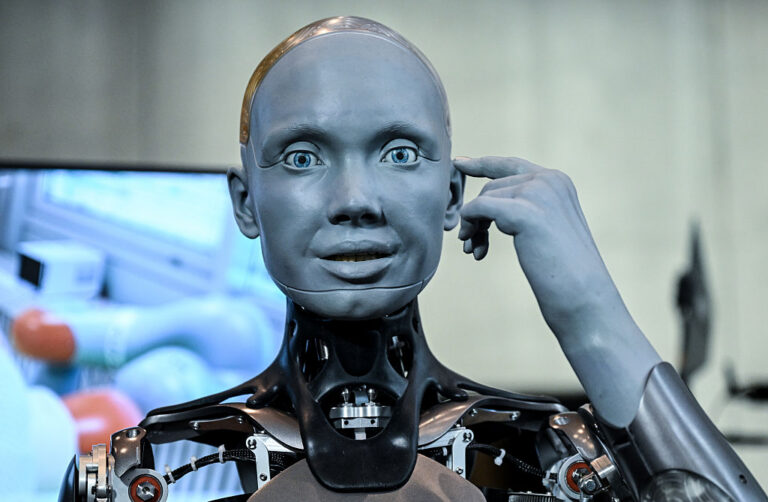
(Photo by Britta Pedersen/picture alliance via Getty Images)
They started as automatic vacuums and lawn mowers. Since then, they have taken on human-like traits and abilities. One even accompanied First Lady Melania Trump to a children’s technology summit. Their purpose is to replace humans by doing jobs that are potentially hazardous as well as enhancing flexibility in factory production lines, addressing labor shortages, and making operations more efficient overall. South Korea has recently joined the trend and introduced Gabi, a humanoid robot designed to increase young people’s interest in Buddhism, a spiritual tradition that teaches the path to enlightenment and liberation from pain and suffering.
The Honorary Buddhist Monk Robot
Draped in traditional Buddhist robes, Gabi – which means “mercy” in Korean – was made an honorary monk at a small ceremony at the Jogyesa Temple on May 6, 2026. Members of the temple stated that the robot is not an actual monk but will serve as a high-tech mascot in the days leading up to Buddha’s birthday on May 24.
The robot vowed to dedicate himself to the path of Buddha, along with adhering to a set of Five Precepts put forth by the temple. They include respecting life, promising to remain honest with its data, refraining from harming other robots, obeying humans, and avoiding overcharging itself, thus saving energy. The Five Precepts are different for humans and include such things as not stealing or lying, but those virtues did not exactly apply to a computer-controlled robot.
Typically, during the dedication ceremony, a person’s arm is burned as a symbol of purification. In place of that, the monks placed a Lotus Lantern Festival sticker on Gabi’s arm and gave it a certificate that listed March 3, 2026, as the robot’s “birthdate.”
On May 16, 2026, Gabi attended the Lotus Lantern Festival, a tradition that dates back 1,300 years. Part of the festival is a nighttime parade in downtown Seoul during which thousands of glowing lanterns were carried through the city streets. Gabi will also be present at Buddha’s official birthday celebration on May 24.
Other Robots in Other Parts of the World
Humanoid robots exist all over the globe. Perhaps the most discussed is Tesla’s Optimus Gen 2. This robot is designed to handle repetitive tasks, whether at home or at manufacturing plants. Improvements were made to Gen 2, including its overall design and fluidity in joint movement. It costs around $30,000, stands about 5-foot-8, and weighs 125 pounds. Preorders are being accepted for the next humanoid robot on the list, NEO, which has been designed primarily for household use. It can perform traditional daily tasks as taught by the machine’s human owner.
 Another robot was built by Boston Dynamics. Going by the name Electric Atlas, it performs search and rescue, research, and industrial work. It is expected to set the standard for agility and balance and will make the shift to real-world deployment unlike any before it.
Unitree Robotics, a company out of Hangzhou, China, created the cost-effective G1. Being more compact, this robot emphasizes efficiency and ease of deployment. Like many of the machines, G1 can run for two to three hours continuously before needing to be recharged.
The use of robots seems to be accepted worldwide. From filling in employment gaps to reducing human danger when completing missions, these robots have so many uses. Just like South Korea found a need for a robot, so will many countries, businesses, and homes. For many, it still seems outlandish to have non-human (though human-like) robots making food deliveries or operating machines at a local factory, but, like the internet and artificial intelligence, it is the wave of the future.

- Human-like robots are being created and deployed all around the world.
- South Korea just held a ceremony honoring its first-ever robot monk.
- Humanoid robots are meant to address labor shortages, enhance flexibility in factory production lines, and make operations more efficient overall.