In the wake of World War II, a new era of poetry emerged: Postmodernism. Widely considered a reaction to the modern literary works that came before it, early Postmodern poetry reflected a growing skeptical perspective that emphasized uncertainty and was… Read More
With such life-altering inventions as the automobile and incandescent lightbulbs, the world changed dramatically in the early 20th century. Poets, writers, and other creatives whose lives were surrounded by technological advancements believed the arts needed a daring new approach to… Read More
The Victorian era of poetry took place during the reign of the United Kingdom’s Queen Victoria, running from 1837 to 1901 after the Napoleonic Wars and before the beginning of World War I. Victorian poets kept many of the Romantic… Read More
After neoclassicism dominated the literary arts with logic and reason, a new age focused on nature and emotions emerged in the late 18th and early 19th centuries: Romanticism. Unlike poetry written during the Enlightenment, which followed strict rules and emulated… Read More
Neoclassical poetry dominated the 18th century, emerging at the end of the Renaissance around 1650 and running until the year 1800. It developed during the Enlightenment, a period defined by order that was also referred to as the Age of… Read More
For millennia, writers have expressed themselves through poetry, an intimate literary art form that dates back to 2000 BC. The earliest recognized form of poetry is called “epic,” a type of long narration that usually explores an ancient character’s adventures…. Read More
Poetry often brings one prolific writer to mind: William Shakespeare. Arguably the most famous poet to ever put quill to parchment, Shakespeare rose to prominence during the English Renaissance, a period of major cultural change that developed in the late… Read More
John Keats lived just 25 years, published only a small body of work, and spent much of his short life convinced that his poems would not last. He wrote during an era of disease, strict social class boundaries, and ruthless… Read More
Words can hop, skip, and even dance on the page when you’re reading a poem by E. E. Cummings. He didn’t believe poetry had to sit still. To him, words were alive, meant to move, twist, and surprise. E.E. Cummings… Read More
Imagine someone who loved the sound of waves breaking on the shore, the chatter of a busy street, and the soft rustle of grass underfoot, and then turned all those sounds into poetry. That person was Walt Whitman. He was… Read More
Have you ever seen the musical Cats, a play about a tribe of felines called the Jellicles? Those characters began as poems written by a playful, puzzle-loving poet named T. S. Eliot, short for Thomas Stearns Eliot. He was born… Read More
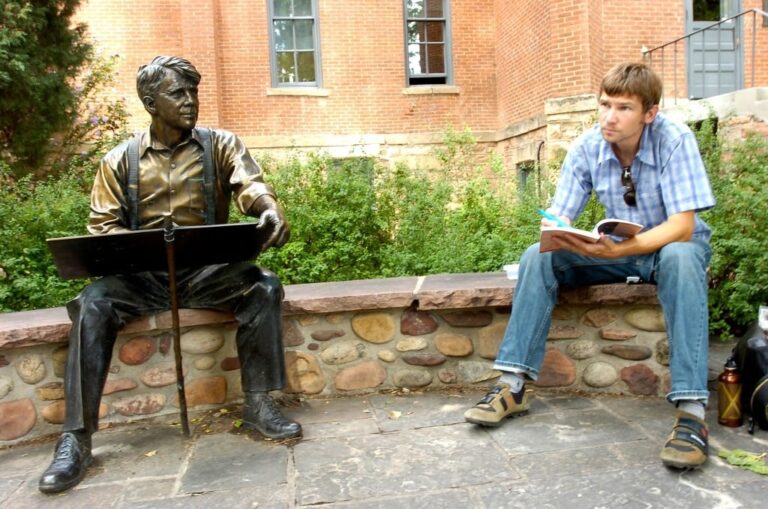
“No tears in the writer, no tears in the reader. No surprise in the writer, no surprise in the reader.” – Robert Frost Robert Lee Frost (March 26, 1874 – January 29, 1963) is still today one of America’s most… Read More