Neoclassical Poetry Favored Ancient Greek and Roman Styles
Reason and logic took center stage in the 18th century.
By: Elizabeth Lawrence | January 26, 2026 | 587 Words
(Photo credit Getty Images)
Neoclassical poetry dominated the 18th century, emerging at the end of the Renaissance around 1650 and running until the year 1800. It developed during the Enlightenment, a period defined by order that was also referred to as the Age of Reason.
Many books, scientific essays, laws, and, of course, poems were written during the Enlightenment in the midst of multiple wars, including the American and French revolutions, both inspired by Age of Reason principles.
Neoclassical Poetry
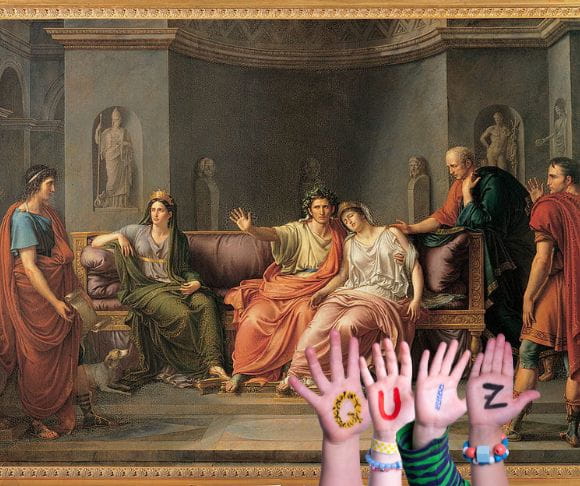
Neoclassical poetry reintroduced ancient Greek and Roman styles, adopting classic forms and themes. Values attributed to the Enlightenment were often the focus of such poems, including reason, order, and clarity.
The era’s poetry blended classical styles and modern issues, with writers producing satire, fables, rhyming poems with couplets, and parodies. Poets during the Enlightenment believed art, like society itself, functioned best when there were clear rules. Where later Romantic poets would celebrate emotion, neoclassical writers believed logic was more important than almost anything else.
According to Poem Analysis, Enlightenment poets valued common sense, well-ordered structure, accurate and believable content, and realistic characters. They also typically portrayed humankind as flawed.
Three Periods of Neoclassicism
There are three periods in neoclassical literature: the Restoration period, the Augustan period, and the Age of Johnson.
The Restoration occurred when the monarchy was restored after the beheading of England’s King Charles I. During this period, the style was concise, featuring short sentences. The period’s main influences were John Milton, John Bunyan, and John Dryden.
 During the Augustan period, writers adopted the styles of Greco-Roman writers. “The writings of Alexander Pope fall into this period. His long poem, ‘An Essay on Criticism,’ published in 1711 is a great example,” Poem Analysis noted.
The final period of neoclassicism, the Age of Johnson – named after writer Samuel Johnson – is also referred to as the Age of Transition. “Lexicographer, essayist, critic, philosopher – Johnson became in many ways the living embodiment of the Neoclassical ideal in its final form. His mind was as disciplined as Pope’s verse, his prose as weighty as Dryden’s couplets, but his moral seriousness reached deeper,” explained the Literary Scholar, an independent educational website. “Where earlier wits had often laughed at the world’s follies, Johnson looked upon them with grave compassion and unflinching judgement.” Johnson died in 1784 just before the end of the Neoclassical era.
A Famous Neoclassic Poem
Neoclassical poets preferred formal language, especially favoring Greek and Latin vocabulary. They sought refinement, insisting a sophisticated style was critical for delivering their important messages. This approach is perhaps best illustrated by one of Johnson’s most famous poems, The Vanity of Human Wishes:
The teeming mother, anxious for her race,
Begs for each birth the fortune of a face:
Yet Vane could tell what ills from beauty spring;
And Sedley curs’d the form that pleas’d a king.
Ye nymphs of rosy lips and radiant eyes,
Whom Pleasure keeps too busy to be wise,
Whom Joys with soft varieties invite,
By day the frolic, and the dance by night,
Who frown with vanity, who smile with art,
And ask the latest fashion of the heart,
What care, what rules your heedless charms shall save,
Each nymph your rival, and each youth your slave?
Neoclassical poetry ultimately fell out of favor as the 18th century came to a close, giving way to the Romantic movement.

- Neoclassical poetry dominated the 18th century.
- Neoclassical poetry reintroduced ancient Greek and Roman styles, adopting classic forms and themes.
- Samuel Johnson is one of the most famous neoclassical writers.