Robert Frost – One of America’s Favorite Poets
President John F. Kennedy requested Frost speak at his presidential inauguration.
By: Kelli Ballard | July 30, 2025 | 901 Words
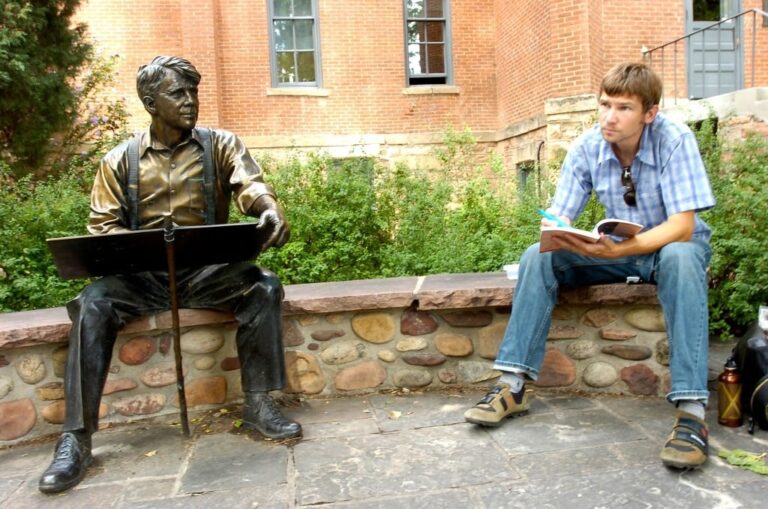
(Photo by Paul Aiken/Digital First Media/Boulder Daily Camera via Getty Images)
“No tears in the writer, no tears in the reader. No surprise in the writer, no surprise in the reader.”
– Robert Frost
Robert Lee Frost (March 26, 1874 – January 29, 1963) is still today one of America’s most popular poets. Born in San Francisco, California, he moved to Lawrence, Massachusetts, in 1884 after his father passed away. Here, he was inspired by rural life, and his poetry is known for its realistic depictions of that lifestyle.
Robert Frost – One of America’s Favorite Poets
What makes Frost so popular, even today? His style and storytelling are appealing and relatable to most people. Mr. Frost wrote about contemporary ideals and issues, describing them with such vivid imagination that readers can visualize his words and feel a part of the work. He used colloquial conversation so that most could read and understand. For example, “Nothing Gold Can Stay” is one of his most popular poems. It’s short, but it paints a vivid picture:
Nothing Gold Can Stay
Nature’s first green is gold,
Her hardest hue to hold.
Her early leaf’s a flower;
But only so an hour.
Then leaf subsides to leaf.
So Eden sank to grief,
So dawn goes down to day.
Nothing gold can stay.
Frost wrote many poems, but interpreting them can be a challenge as there are several ways they could be understood. One of his most famous, “The Road Not Taken,” for example, has a couple of ways people think it means. The first suggests the poem is about isolation as the person traveling through the forest wants to make his own path in the world. The second idea is that it’s about the meaning of life as the traveler wants whatever his choice is to have an impact. What are your thoughts?
The Road Not Taken
Two roads diverged in a yellow wood,
And sorry I could not travel both
And be one traveler, long I stood
And looked down one as far as I could
To where it bent in the undergrowth;
Then took the other, as just as fair,
And having perhaps the better claim,
Because it was grassy and wanted wear;
Though as for that the passing there
Had worn them really about the same,
And both that morning equally lay
In leaves no step had trodden black.
Oh, I kept the first for another day!
Yet knowing how way leads on to way,
I doubted if I should ever come back.
I shall be telling this with a sigh
Somewhere ages and ages hence:
Two roads diverged in a wood, and I—
I took the one less traveled by,
And that has made all the difference.
But Frost didn’t become a famous poet for a while. At first, he didn’t have much luck selling his poems and books. Frustrated, he and his wife moved to England where his work was more accepted. His growing fame made him popular back in America, and he was well-received when he returned.

Robert Frost (Photo by: GHI/Universal History Archive/Universal Images Group via Getty Images)
In 1961, Frost was asked to read a poem at the presidential inauguration of John F. Kennedy. He’d written a poem called “Dedication” for the ceremony but was not able to read it because the sun was too bright. Kennedy had originally asked him to read “The Gift Outright,” so Frost recited that poem, but with a revised last line.
In 1963, President Kennedy gave a speech in dedication of the Robert Frost Library in Amherst, Massachusetts. “In honoring Robert Frost,” he said, “we therefore can pay honor to the deepest source of our national strength. That strength takes many forms and the most obvious forms are not always the most significant. Our national strength matters; but the spirit which informs and controls our strength matters just as much. This was the special significance of Robert Frost.”
Frost died in 1963, but by that time he had not only delivered a speech at a presidential inauguration, he had also earned four Pulitzer Prizes, been awarded the Congressional Gold Medal, and served as a consultant for the Library of Congress. Kennedy said that Frost “saw poetry as the means of saving power from itself. When power leads man towards arrogance, poetry reminds him of his limitations. When power narrows the areas of man’s concern, poetry reminds him of the richness and diversity of his existence. When power corrupts, poetry cleanses.”
Robert Frost was passionate about his work and wanted it to inspire others. He said, “One thing I care about, and wish young people would care about, is taking poetry as the first form of understanding. If poetry isn’t understanding all, the whole world, then it isn’t worth anything.”
- Robert Frost is one of America’s favorite poets, but it didn’t happen quickly. For a long time, he had trouble selling his works. Only after moving to England did he really become popular in the US.
- Robert Frost was invited by President John F. Kennedy to recite a poem at his inauguration. Afterward, Kennedy gave a speech in dedication of the Robert Frost Library in Amherst, Massachusetts.
- Frost died in 1963. His poetry won him four Pulitzer Prizes, the Congressional Gold Medal, and a gig as a consultant at the Library of Congress.
Test Your Knowledge – Take the Quiz