E.E. Cummings – Making Poetry Into Puzzles
The poet who didn’t believe in traditional writing.
By: Kelli Ballard | November 3, 2025 | 1006 Words
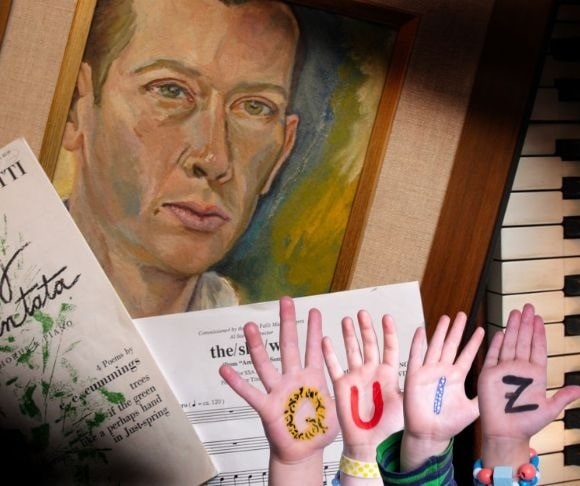
(Photo by David Jennings/Digital First Media/Boulder Daily Camera via Getty Images)
Words can hop, skip, and even dance on the page when you’re reading a poem by E. E. Cummings. He didn’t believe poetry had to sit still. To him, words were alive, meant to move, twist, and surprise.
E.E. Cummings and His Early Life
Born Edward Estlin Cummings on October 14, 1894, in Cambridge, Massachusetts, he grew up in a lively household full of ideas. His father, Edward Cummings, was a Harvard professor and minister who loved big discussions about faith and philosophy. His mother, Rebecca, filled their home with stories and art, encouraging young Estlin (as his family called him) to write his own poems and draw his own pictures. That combination of curiosity and creativity shaped the person he would become.
As a child, Cummings wasn’t afraid to play with language. He’d invent silly words, draw pictures around his poems, and write in ways that made people tilt their heads and think. He once said his mother was the first person who ever told him he was a poet – and she was right. By the time he was ten, he was writing poems nearly every day.
Cummings attended the Cambridge Latin School, where he studied Latin and Greek, and then went on to Harvard University. At Harvard, he studied literature, art, and philosophy, earning both a bachelor’s degree in 1915 and a master’s degree in 1916. He also started publishing his poems in the Harvard literary magazines, where readers first noticed his unique voice. Even back then, he wasn’t following the normal rules. His poems looked different. Some were short, others were shaped like objects, and some were written with words scattered all over the page.
When World War I began, Cummings wanted to help. In 1917, he joined the Norton-Harjes Ambulance Corps in France, driving vehicles that carried wounded soldiers. But during his service, a mix-up with letters led French authorities to suspect him of spying. He was arrested and spent three months in a detention camp. Instead of becoming bitter, he observed everything and later turned those experiences into his first book, The Enormous Room (1922), which made him famous for his humor and humanity even in hard times.
The Unconventional Poet
After the war, Cummings returned to the United States determined to live and write on his own terms. He began publishing poetry that looked and sounded nothing like anyone else’s. He didn’t care about capital letters, proper punctuation, or neat grammar. Sometimes he wrote his name entirely in lowercase: “e e cummings.” He didn’t invent this version himself, but it fit his playful spirit.
 Cummings treated language like art supplies. A poem could curve, stretch, or drop down the page. A single word could stand alone in a sea of white space. He believed that a poem’s shape mattered just as much as its sound. His goal was to make readers feel something such as surprise, love, laughter, or wonder, just by looking at the words.
One of his best-known poems, “i carry your heart with me,” shows how he could take simple words and make them powerful through rhythm and emotion. The poem expresses deep love, but in plain, honest language—no fancy vocabulary, just feeling.
i carry your heart with me (i carry it in
my heart) i am never without it (anywhere
i go you go, my dear; and whatever is done
by only me is your doing, my darling)
i fear
no fate (for you are my fate, my sweet) i want
no world (for beautiful you are my world, my true)
and it’s you are whatever a moon has always meant
and whatever a sun will always sing is you
here is the deepest secret nobody knows
(here is the root of the root and the bud of the bud
and the sky of the sky of a tree called life; which grows
higher than soul can hope or mind can hide)
and this is the wonder that’s keeping the stars apart
i carry your heart (i carry it in my heart)
Cummings also wrote about the world around him. He loved nature and questioned modern life, sometimes poking fun at machines and crowds. In his poem “pity this busy monster, manunkind,” he warned that technology could make people forget how to be human.
But what truly makes Cummings special is how much joy and individuality shine through his work. He believed that every person should be fully themselves, even if that meant breaking rules. One of his most famous lines says: “may I be I is the only prayer—not may I be great or good or beautiful or wise or strong.” He wanted readers, especially young ones, to trust their own voices.
 Cummings wasn’t just a poet. He was also a painter and essayist. His colorful paintings were shown in galleries in New York and Paris. He saw art and poetry as twins, two different ways of expressing wonder about the world.
Throughout his career, Cummings published more than 2,900 poems, along with plays, essays, and drawings. Some critics at the time thought his work was too strange. Others loved it. Over the years, his style became one of the most recognizable in American poetry. He received many awards, including the Bollingen Prize for Poetry in 1958.
He spent much of his later life at his quiet home in Silver Lake, New Hampshire, known as Joy Farm, where he painted, wrote, and walked in the woods. Cummings died there on September 3, 1962, but his work continues to inspire new generations to see language differently.

- E.E. Cummings was a poet who experimented with alternative spelling, grammar, sentence structure, and other ways of writing that most people wouldn’t consider normal.
- Cummings said his goal was to make people feel something just by looking at his words.
- Cummings served in World War I, but was mistaken for a spy by the French government because a mix up with letters.