Egyptian – The Other First Language
Sumerian may be slightly older, but Egyptian is the ancient tongue known to the modern world.
By: James Fite | June 16, 2026 | 938 Words
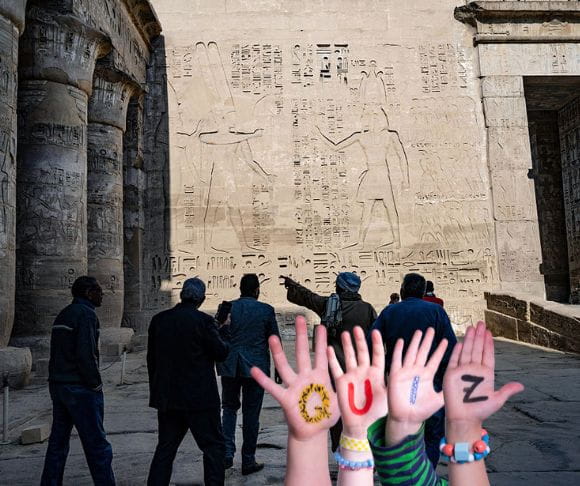
(Photo by John Wreford/SOPA Images/LightRocket via Getty Images)
Sumerian and Cuneiform may have come first – by about 300 years – but if there’s an ancient language and writing system everyone has heard of, it’s Egyptian and Hieroglyphs. In fact, one could call Egyptian “the other first language.” But did you know that Hieroglyphs weren’t the only way to write Old Egyptian? There was a co-script, of sorts, and both the spoken and written forms evolved through time.
Egyptian – A ‘First Language,’ Not Sumerian’s Little Sibling
Many scholars believe that the rise of written language in Egypt followed interactions with Mesopotamian traders, who would have used an early version of Cuneiform. However, the Egyptian language – and writing system – share little to nothing with Sumerian and Cuneiform. While the Mesopotamian language and writing system did technically come first by a few centuries, what emerged in Egypt was unique.
Appearing in spoken form around 3,400 BC and in the beginnings of basic Hieroglyphs by about 3100 BC, what we call Old Egyptian was part of the broad Afro-Asiatic language family. This massive family is home to around 400 languages – including the Semitic languages such as Aramaic, Arabic, and Hebrew – and spans Africa and the Middle East. By contrast, Sumerian was a language isolate, meaning it had no known relatives.
As well, the writing system of the Egyptians was entirely separate from Cuneiform – and has its own mythical origin story. The word Hieroglyph comes from the Greek hiero (holy) and glypho (writing). The Greeks gave the system this name because they thought the elegant pictorial form was something sacred. And they were right. The ancient Egyptians themselves called it medu netjer (the gods’ words).
There are several versions of the origin story for the Egyptian god Thoth, but whatever story one chooses, the origin of language – written and spoken – remains the same: Thoth granted humans this knowledge. He did so freely, but with an expectation of responsibility. Words could hurt, heal, destroy, or even raise the dead, according to ancient Egyptian belief. Egyptologist Rosalie David explained:
“The main purpose of writing was not decorative, and it was not originally intended for literary or commercial use. Its most important function was to provide a means by which certain concepts or events could be brought into existence. The Egyptians believed that if something were committed to writing it could be repeatedly ‘made to happen’ by means of magic.”
A Special Kind of Writing
Cuneiform, the Sumerian writing system, was based on phonograms – that is, symbols that represented sound. The Egyptian Hieroglyphs, on the other hand, were an evolution of pictographs. Each symbol represented a person, place, or thing. This resulted in a considerably large library of easily recognizable characters, but it left no way to show how they related to one another. To solve this, Egyptians added logograms and ideograms – symbols representing individual words and ideas – into the language.
The end result was huge! Ancient Hieroglyphs included more than a thousand characters. And now’s a great time for a note on the name: Remember that the word we use today is Greek. Many people say Hieroglyphics rather than Hieroglyphs. So which one is right? Both. Hieroglyphs is one modern interpretation, while Hieroglyphics (which sounds closer to how the Greeks would have pronounced hieroglifikos) is another. Some even use Hieroglyphs to mean the individual pictorial character and hieroglyphics to mean the writing system itself. All are correct.
 But did you know that, whatever you choose to call them, Hieroglyphs or Hieroglyphics weren’t the only form of Egyptian writing?
Hieroglyphs were great for monumental writing – inscribing ideas in stone, wood, or metal to endure the test of time. But for everyday recordkeeping, it was simply too much. Eventually, Egyptian priests developed a sort of cursive version that was faster and a bit simpler and could be painted on papyrus using reed brushes: Hieratic. Eventually, this form was used for everyday writing as well as official documents.
Hieratic was used – especially for religious texts – as late as the 3rd century BC. But another written form had emerged by then. Demotic script evolved around 650 BC from Hieratic as a more simplified version that was even quicker to write. It was developed to accommodate both the increased volume of written work and changes in the spoken language over the years. It remained in official use until about the 5th century BE.
The final stage of the written language was Coptic, which was a bridge between the ancient languages and the more modern world. It arose after Alexander the Great conquered the region around 332 BC, leading to a Greek occupation and the adoption of some Greek into the language. It lasted until the Arab conquest around AD 640, though many Coptic Christian groups still use the language.
Egypt in the Modern Age
Today, most Egyptians speak Egyptian Colloquial Arabic, also known as Masri, and they write mostly in Literary Arabic, also called Modern Standard Arabic, which is today the official language of about 26 countries. The most commonly spoken “foreign” language is English, though French is also prevalent. But even through all these changes – through Greek, Roman, and Arab conquests – the ancient monumental Egyptian Hieroglyphic language remains, carved in stone in massive pyramids and other monuments, reminders of one of the most powerful and mystic empires in the ancient world.

- The Sumerian writing system Cuneiform was based on phonograms – that is, symbols that represented sound; Egyptian Hieroglyphs were an evolution of pictographs, in which each symbol represented a person, place, or thing.
- Ancient Hieroglyphs included more than a thousand characters.
- Hieroglyphs were great for monumental writing – inscribing ideas in stone, wood, or metal to endure the test of time.