The United States: A Republic Disguised as Democracy
So what is a democracy, and what makes our nation different?
By: James Fite | August 18, 2026 | 1222 Words
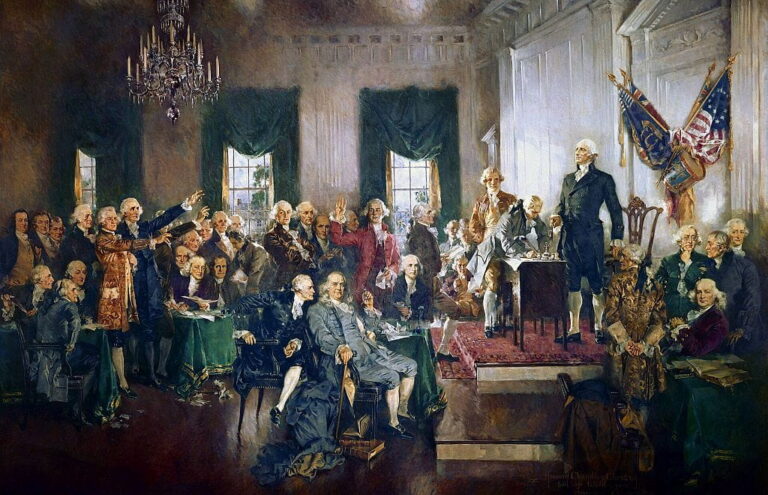
(Photo by: Universal History Archive/Universal Images Group via Getty Images)
Have you ever heard the United States referred to as a democracy? Well, that’s only partly right. There are democratic elements to our government, that’s for sure – but it’s more properly considered a republic. In fact, it’s formally classified as a constitutional federal democratic republic. Now, that might sound complicated – and that’s because it is! So what exactly are republics, democracies, and this strange amalgamation we call a country?
Defining Democracy – It’s Exactly What You Think
Ask anyone to define democracy, and you’ll get answers like “rule by the people,” or “one voice, one vote,” or “majority rule.” All those phrases are accurate. It is exactly what it sounds like: In a pure democracy, everyone who has the right to vote gets one vote on every issue, and the simple majority (that’s 50% plus one or more) wins.
Now, the problem is that holds true no matter what law the simple majority chooses. If 50% plus one person votes to take away the other half less one or more of the population’s right to vote, it happens. There’s no protection for the minority against what James Madison called the tyranny of the majority in Federalist No. 10. When a faction forms a majority, pure democracy allows it to sacrifice the weaker party or individual rights on a whim. Madison also noted that, historically, direct democracies were “spectacles of turbulence and contention.” They were all “as short in their lives as they have been violent in their deaths.”
Let’s take a look further back in time. Athens, the Greek city-state, is the most famous example of a direct democracy. Any free adult male citizen could attend the Pnyx, the hill where they assembled to speak, and vote directly on laws, declarations of war, and executions. There was a high degree of civic engagement – meaning a lot of people participated in city government – but some of the decisions were wild.
In 427 BC, after the city of Mytilene revolted during the Peloponnesian War, the Athenian Assembly voted to execute all its adult male citizens and enslave the women and children. The next morning, after folks had calmed down, they met again and voted to reverse the order. They had to send another ship, this one faster than the first, which arrived just in time to stop the massacre.
From 415 to 413 BC, Athens waged a war voted on by the people against Sicily. It ended poorly, and Athens lost its entire navy. And in 399 BC, a jury of 500 Athenian citizens voted to execute Socrates for failing to acknowledge the city’s gods.
If that doesn’t sound like a great place to live, that’s why so few direct democracies ever lasted and why none are around today. As Madison said, they were all short-lived and violent in their deaths.
The Rise of Republics – A More Familiar Government
Perhaps the most famous republic in history was Rome. It lasted around two and a half times longer than Athens’ democracy, but it had its own problems – as do most republics today. At first glance, Rome might seem similar to the United States. It was governed by a Senate, a group of elected officials who voted among themselves to make laws and govern the city and later the nation.
But Rome didn’t have the equality in voting power that we have today. The members of the Senate and other leading councils were elected, but they were chosen only from an elite noble and wealthy merchant class, and only those high-status people had the right to vote. This rule by the elites eventually led the Senate to grant Octavian the title Augustus, giving him full power as emperor and turning the Roman Republic into the Roman Empire.
Most modern examples, such as Germany, Italy, India, Ireland, and the United States, install further safeguards against totalitarian rule by elites. Then there are ones that don’t take same path as Rome. The Islamic Republic of Iran, for example, is run by a religious “supreme leader” and “Guardian Council” that can veto any legislation. Right now, the military seems to be in control. The People’s Republic of China is established by constitution as a republic, but it’s controlled by a single ruling party that runs all the elections, courts, and military branches, and only members of that party are allowed to run for office.
The Constitutional Difference and Separation of Powers
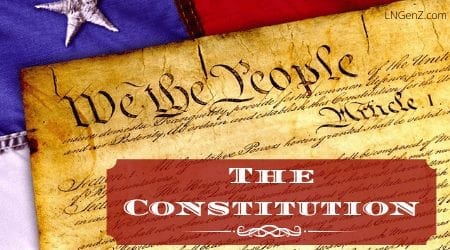
With the two-body US Congress, made up of the House of Representatives and the Senate, and with each state having a similar (though not necessarily identical) legislative setup, the United States looks a lot more like a republic than a democracy. But as mentioned before, some democratic safeguards are built in to prevent totalitarianism. For one, the Constitution serves as the supreme law of the land and prohibits the federal government from doing certain things. It also establishes the different branches of the government that work together to get things done and also keep each other in check.

The American flag flying over Fort McHenry (Photo by GraphicaArtis/Getty Images)
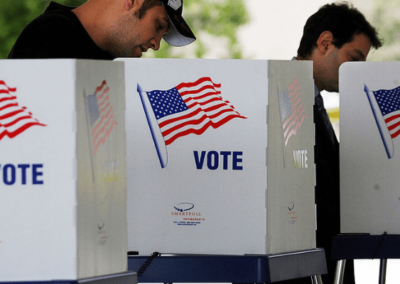
People vote in their states for their legislators and governors. The legislators make laws at the state level that governors sign or veto. Then people in every state vote for whom they will send to the US House of Representatives. People also vote at the state level for whom they want to be president, but that isn’t the final tally
At one time, various state legislatures voted to fill the US Senate. This was a way that the Constitution allowed both the people to have a voice and the state governments to have a say. That all changed in 1913, when the 17th Amendment made senators popularly elected.
But one state sovereignty safeguard remains. When people vote for president, they are selecting a set of electors. When one candidate wins in a state, the state sends the electors dedicated to that candidate for the final vote. When all the electors from all the states are gathered, they determine who gets to be president.
The court system is where people and governments can sue over laws they think violate the Constitution (or the various constitutions of the individual states). So, you see, the United States isn’t a democracy, where a simple majority can choose to abuse the minority. But it isn’t a pure republic, either, in which a single powerful entity or a certain class of wealthy or powerful elites run the country with no input from everyday folks. Rather, it’s a clever mix of both, built to keep the people safe from powerful elites who could be corrupted – and even, by restricting the tyranny of the majority, from themselves.

- In a pure democracy, everyone who has the right to vote gets one vote on every issue, and the simple majority (that’s 50% plus one or more) wins.
- A republic is governed by a Senate, a group of elected officials who vote among themselves to make laws and govern.
- With the two-body US Congress, made up of the House of Representatives and the Senate, and with each state having a similar (though not necessarily identical) legislative setup, the United States looks a lot more like a republic than a democracy.