Space’s Mysterious Black Holes
There is still much to learn about the mysterious space objects.
By: Kirsten Brooker | June 4, 2026 | 770 Words
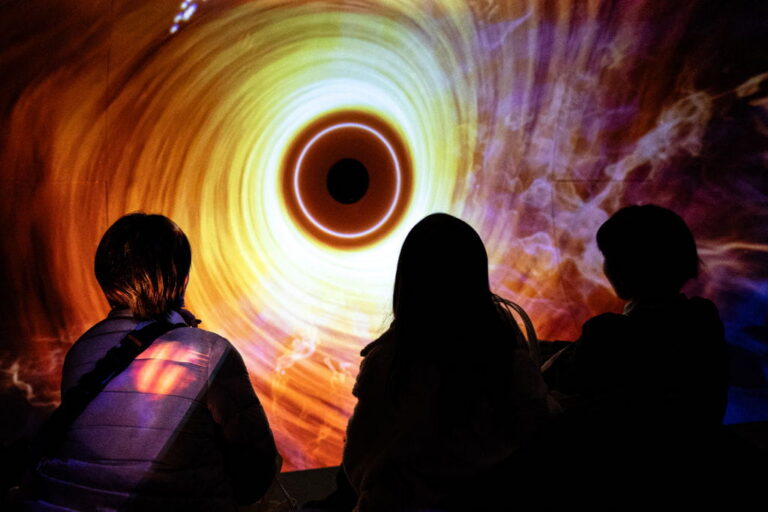
(Photo by Travis P. Ball/SXSW Conference & Festivals via Getty Images)
Although scientists have thoroughly studied oceans and space, there is still so much that is unknown about them. Black holes are one of the mysteries that even the smartest scientists and researchers have not been able to fully explain. There are some things, however, that have been found to be true about the mysterious space objects.
What Are Black Holes?
While this question is not easy to fully answer, a few facts about black holes help us better understand what they are and where they come from. A black hole is defined as a dense astronomical body that traps light and other particles using its strong gravitational pull. The smallest known black holes contain more than three times the mass of the sun. The largest are nearly incomprehensible as they contain more than tens of billions of times the mass of the sun and can be as large, or larger, than entire solar systems. Most black holes consist of five parts: the singularity, relativistic jet, photon sphere, event horizon, and accretion disk. Let’s take a closer look at these.
- Singularity – The central point of infinite density and zero volume within a black hole, in which spacetime curvature becomes endless and all rules of physics become irrelevant.
- Relativistic Jet – A plasma stream that moves at high speeds away from the poles of a black hole. These beams of ionized matter move at near light speeds and can sometimes stretch far beyond their host galaxy.
- Photon Sphere – The region where light particles are forced into a path that orbits a black hole rather than escaping or entering the hole.
- Event Horizon – The boundary of a black hole in which nothing can escape. Anything that reaches this point of a black hole is permanently trapped.
- Accretion Disk – A hot, glowing disk made up of gas and dust that rapidly rotates around a black hole as it is gradually being pulled to its center.
There are four types of black holes: stellar-mass, intermediate-mass, supermassive, and primordial — or hypothetical. Each type is primarily based on the size of the black hole. Other differences among the different types are their formation, location, and observational status. Stellar-mass black holes are made up of three to a hundred solar masses and and formed by the collapse of large stars during supernova explosions. They are located throughout galaxies and are detected mostly through X-ray emissions and gravitational waves. Intermediate-mass black holes are made up of hundreds to thousands of solar masses and are believed to be formed through the merging of other, smaller black holes. Their location is hypothetical – or unproven – though there is evidence of these objects in dense star clusters. Supermassive black holes, made up of billions of solar masses, are the largest. Their formation is unclear, and they are found at the centers of most galaxies. Finally, primordial black holes have no confirmed detections. Their mass ranges from microscopic to many solar masses, and they can be located anywhere in space. The formation of primordial black holes is hypothetical but believed to occur when there are quantum fluctuations or spikes in density that took place in the early universe.
The Life Cycle
Priya Natarajan, an astrophysicist at Yale University, claims that black holes form in two different ways. “They either gobble gas and material from around them, or they collide with other black holes,” she says. Once formed, much like stars, black holes undergo some form of a life cycle.
 They get continuously larger in size by accreting mass from surrounding gas, dust, and stars and by merging with other small black holes. Once they reach maturity (the stable phase), they can become inactive for a period of time. While in this phase, they are undetectable until matter begins falling into them again.
Their final stage of life is called evaporation. In 1974, Stephen Hawking, an English theoretical astrophysicist, cosmologist, and author, suggested that the radiation emitted from the hole causes it to slowly lose mass, shrink, and eventually evaporate completely. This process is referred to as Hawking radiation.
Black holes remain among the most fascinating and mysterious subjects in astronomy. Although scientists have learned a lot about them, many questions remain unanswered. As technology improves and space research continues, black holes may help scientists better understand the forces that shape the universe.

- Black holes are extremely dense objects whose gravity is so strong that even light cannot escape.
- Scientists classify black holes into types based on their size, formation, and location in space.
- Even though researchers know more than ever before, black holes still hold many mysteries that could reveal new information about the universe.