Gen Z and Gen Alpha Pupils Do Better With Paper Than Screens
Researchers find more positive results when students learn from books.
By: Andrew Moran | June 17, 2026 | 693 Words
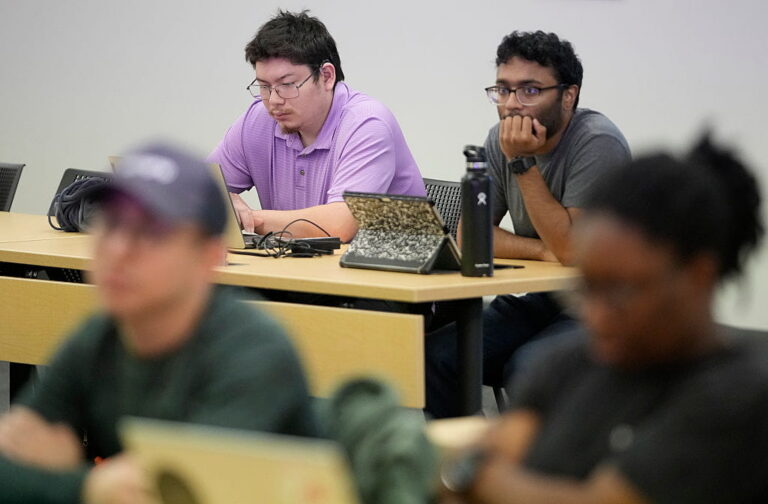
(Melissa Phillip/Houston Chronicle via Getty Images)
Across the globe, researchers have uncovered extensive evidence of the detrimental impact of computer screens on Gen Alpha (2010 to 2025) and Gen Z (1995 to 2009) students. Add artificial intelligence (AI) to the mix, and the entire education system may need to throw millions of dollars’ worth of iPads out the window.
Sweden made international headlines when it was reported that the government is reversing course and replacing screens with paper and pencils. It is a sharp reversal from the previous compulsory initiative of embracing laptops and tablets. The new “from screen to binder” campaign is in response to research showing the harmful effects of screens on learning, attention, and overall brain development.
Gen Alpha and Screens
Gen Alpha, born primarily from millennials, is the first generation to be fully immersed in the digital world, from streaming platforms to mobile devices to screen-based learning. It is also the main generational victim of government schools relying on screens to teach educational material, from phonics to mathematics.
For example, a South Korean study found that young adults had higher oxygen‑rich blood in the prefrontal cortex, a brain region associated with memory, when they read on paper. Put simply, students’ brains were more efficient when learning from paper.
In another instance, an Israeli study found that when six- to eight-year-olds read on paper, there was more power in high-frequency brainwaves and less on screens.
These are only a small sample of the immense number of research papers showing the same patterns: Teachers are not helping children by using tablets, computers, and other digital tools to teach basic arithmetic or words.
But what about AI’s effects on Gen Z? The data are just as troublesome as for screens.
Artificial Unintelligence
In the 2000s, students were caught cheating by using Google. Years later, their dependence on Wikipedia became an issue for professors. These days, relying on ChatGPT has become a key challenge for educators everywhere. But while supporters argue that AI is merely another tool that society needs to adapt to, the data show that the way kids are using it is having negative consequences for the future.
 When the results of a recent Chinese study involving more than 26,000 students were released, the conclusion was thought-provoking. Scientists found that homework improved by 20% and that students spent 20% less time on it. At exam time, they performed 20% worse.
Another paper, published in December, compared more than 2,000 college admission essays by students before ChatGPT arrived on the scene with essays generated by GPT-4. Researchers found that students who do not use large language models (LLMs) are as much as eight times more creative than students with access to these models (ChatGPT, Grok, Claude, and others).
Even students accept that AI is doing more harm than good. A new survey from RAND’s American Youth Panel uncovered that 67% of students agreed that AI erodes their critical thinking skills. Despite this acknowledgment, a majority of middle schoolers and high schoolers increased their use of AI for homework.
Too Late?
Because government schools are slow to adapt to evolving data, is it too late to change how we teach Gen Alpha? Will we have made reforms in time for Generation Beta?
The damage may have already been done to the last two generations. Since 2012, the share of nine- and 13-year-olds reporting no homework has risen substantially. Simultaneously, the share of kids in these age ranges stating they read for pleasure has dropped sharply.
Some educators have attempted to mask the deterioration of children’s proficiency, whether in math or reading, by lowering standards, passing everyone, and using “gradeflation.” So it is really up to parents to foster a home environment of more reading, greater thinking, and less watching.
In other words, ditch Bluey, read 20,000 Leagues Under the Sea, and dump the tablet.

- Across the globe, researchers have uncovered extensive evidence of the detrimental impact of computer screens on Gen Alpha (2010 to 2025) and Gen Z (1995 to 2009) students.
- Sweden made international headlines when it was reported that the government is reversing course and replacing screens with paper and pencils.
- It is important to parents to foster a home environment of more reading, greater thinking, and less watching.