Crazy Horse Memorial – A Mountain of a Monument
There’s a new monument coming to the Black Hills.
By: James Fite | August 11, 2026 | 734 Words
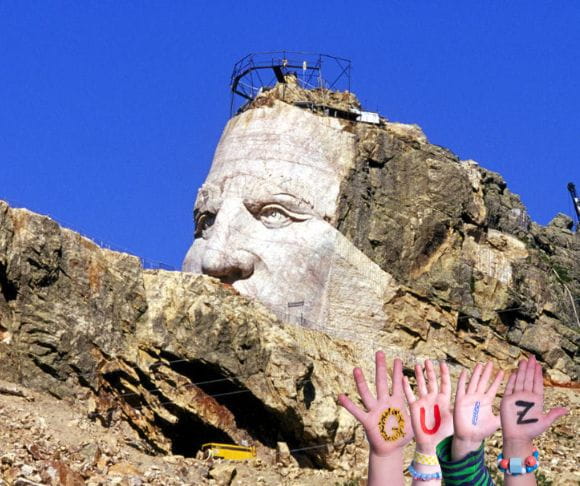
(Photo by Buddy Mays/Getty Images)
Both the United States and the Confederacy have their heroes memorialized in granite at Mount Rushmore and Stone Mountain, respectively. But there’s an even bigger monument being built in the Black Hills of South Dakota to honor a Native American hero: Crazy Horse. Just 17 miles from Mount Rushmore, the Crazy Horse Memorial will be the largest sculpture in the world once complete – but that will probably still be decades from now!
The Crazy Horse Origin Story
Lieutenant Colonel George Armstrong Custer and 261 men of the US 7th Cavalry died during the Battle of Little Bighorn fought June 25-26, 1876. Known as Custer’s Last Stand, this was the greatest – and last – victory for the Plains Indians against the US military during the Great Sioux War, and it immortalized three Native American leaders: Sitting Bull, Crazy Horse, and Chief Gall.
Crazy Horse, the Lakota warrior known in his own language as Tȟašúŋke Witkó (literally, “his horse is crazy”), was born around 1840 and died at Fort Robinson, Nebraska, on September 5, 1877, from a fatal bayonet wound.
In 1939, just two years before Mount Rushmore was completed, Lakota Chief Henry Standing Bear wrote to Polish-American sculptor Korczak Ziolkowski, who had briefly worked on Rushmore under Gutzon Borglum. He asked the sculptor to create a monument honoring an indigenous hero, declaring in his letter: “My fellow chiefs and I would like the white man to know the red man has great heroes, too.”
Ziolkowski accepted the commission and returned to the Black Hills. Construction of the Crazy Horse Memorial began on June 3, 1948. From the beginning, both artist and chief agreed the project would never accept federal funding. Instead, it relies entirely on private donations and visitor submissions.
A Monument – and Timeline – of Epic Proportions
The Crazy Horse Memorial is a multi-generation project for a variety of reasons. For one thing, refusing government funding means construction moves at the pace of donations and usage fees. For another, though, the gargantuan size of the project means – even in the modern world – decades worth of work. Ziolkowski initially estimated this would take a total of 30 years. It remained unfinished at his death in 1982, after 34 years of work.
 Right now, an estimated 10% of the mountain sculpture is complete after nearly 80 years of work. That might not sound like much, but you have to understand this isn’t a big carving into the side of a mountain – this is a massive sculpture that turns an entire mountain into a statue. Crazy Horse’s face was completed and dedicated in 1998. It measures 87.5 feet – significantly larger than all four heads at Mount Rushmore combined.
His outstretched arm and hand, measuring 263 feet, have taken shape but still have some detail work before they’re fully finished. At present, workers are carving Crazy Horse’s hairline, shoulder, and the top section of the horse’s mane and head. The remaining 90% of the rock removal involves the giant body of the horse and the rest of the mountain structure. There are millions of tons of granite still to be blasted away.
Due to the scale of this job, it’s measured in milestones, and no final date is planned yet. Project estimates suggest the hand, arm, shoulder, hairline, and top portion of the horse’s head could be done by 2037, but the best guess is that the full project being completed will take several more decades.
When done, though, the monument’s 563-foot height and 641-foot length will easily qualify it as the largest carved rock sculpture on Earth. It will be more than four times larger than Mount Rushmore. It will be three times wider and six times taller than Stone Mountain. In fact, the Crazy Horse face alone is almost as tall as Stone Mountain’s entire carving.
Chief Standing Bear and Ziolkowski planned a massive undertaking and refused to accept government funding. The goal was less about memorializing Crazy Horse himself – a leader who refused to have his photo taken – and more about honoring his and the Lakota people’s independent spirit. Nearly 80 years later, the project continues, showing that same fiercely independent spirit is still alive today.

- The Crazy Horse Memorial is designed to be the world’s largest mountain carving.
- The memorial is 100% privately funded, using no government money at all.
- As big as it will be, the Crazy Horse Memorial is only about 10% finished. It will take several more decades to complete.