Mount Rushmore – Majestic Stone Carvings for American Giants
A feat of engineering and art in the Black Hills.
By: James Fite | July 28, 2026 | 707 Words
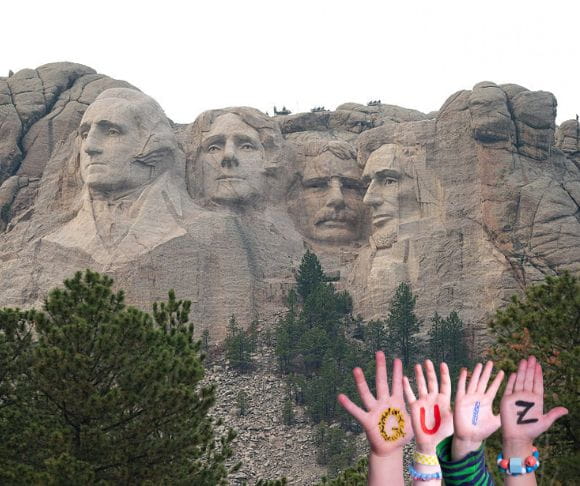
(Photo by Chip Somodevilla/Getty Images)
Have you ever wondered how a big granite mountain in South Dakota became one of the world’s most recognizable memorials? Mount Rushmore, located in the Black Hills, is more than just a popular tourist attraction; it’s a feat of 20th-century engineering and a permanent reminder of four defining eras in American history.
Mount Rushmore – How It Came to Be
South Dakota state historian Doane Robinson came up with the idea for a massive carved monument in 1923. His idea was to depict regional figures, such as Lewis and Clark, Red Cloud, and Buffalo Bill Cody, to boost tourism.
In 1924, Danish-American sculptor Gutzon Borglum was hired to make the dream a reality, and he insisted the monument focus on national figures to make it a national landmark rather than simply a regional one. The final lineup turned out to be George Washington, representing the nation’s birth and struggle for independence; Thomas Jefferson, symbolizing US expansion and growth; Abraham Lincoln for unity and freedom; and, finally, Theodore Roosevelt for the nation’s development, symbolizing economic power, conservation, and America’s global stature.
So if it was dreamed up by Doane Robinson and designed by Gutzon Borglum, why do we call it Mount Rushmore? In 1885, Charles E. Rushmore, a New York attorney engaged in inspecting mining claims in the region, asked a local guide what the peak was called. The guide reportedly joked, “We’ll call it Rushmore Peak,” and the name stuck.
A Stunning Show of Ingenuity
Work began on Mount Rushmore on Oct. 4, 1927, and ended 14 years later, on Oct. 31, 1941. Borglum, in fact, died in March 1941, but his son, Lincoln, oversaw the final touches before funding ran out ahead of World War II.
About 90% of the project was blasting out nearly 450,000 tons of rock with dynamite. Then, in a process called honeycombing, workers used jackhammers to drill closely spaced holes, allowing others to chisel away the rest by hand. Bumper-faced hammers were used to smooth out the final surface.
 And while workers spent about six and a half years across that 14-year span dangling mid-air in suspended “bosun’s chairs,” not a single person died on the job.
Borglum also planned to build a secret room behind Lincoln’s head to store the Declaration of Independence and other founding documents, but he never got to finish that. In 1998, a vault containing 16 porcelain enamel panels explaining the monument’s history was sealed up inside the unfinished doorway.
Granite loses about an inch every 10,000 years to erosion, meaning the giant stone heads will remain generally recognizable as human faces for perhaps as long as seven million years! They will be recognizable as Washington, Jefferson, Lincoln, and Roosevelt for at least another half a million years.
A Complicated History
Today, Mount Rushmore brings in more than two million visitors annually to the Black Hills, supporting local travel and hospitality industries. But its own history is one of controversy.
First, the land itself is disputed. The monument is carved into a mountain the Lakota Sioux called Tunkasila Sakpe Paha, or Six Grandfathers. It was a sacred site granted to the Lakota by the 1868 Fort Laramie Treaty, but when gold was discovered, the United States broke the treaty and took back the land.
The US Supreme Court ruled in 1980 that the Black Hills had been taken illegally and offered restitution, but the Sioux Nation has repeatedly refused the money, demanding the return of the land instead.
But that’s not all. Sculptor Borglum had documented connections and political involvement with the Ku Klux Klan. Before working on Mount Rushmore, he designed the Confederate monument Stone Mountain in Georgia, though when his plans were disputed, he walked away from it, leaving it to be finished by others many years later.
A complicated history, however, often surrounds America’s grand monuments, and Mount Rushmore is no exception. Next, we’ll look at Stone Mountain, then yet another monument in the Black Hills, under construction now.

- The four presidents on Mount Rushmore are George Washington, Thomas Jefferson, Abraham Lincoln, and Theodore Roosevelt.
- The monument took 14 years to carve – but it will remain for millions of years thanks to how slowly granite erodes.
- The design, the sculptor, and the land itself have been mired in controversy.