Alexander Graham Bell: The Man Who Invented the Telephone
The first phone call was made in 1876.
By: Elizabeth Lawrence | May 27, 2026 | 596 Words
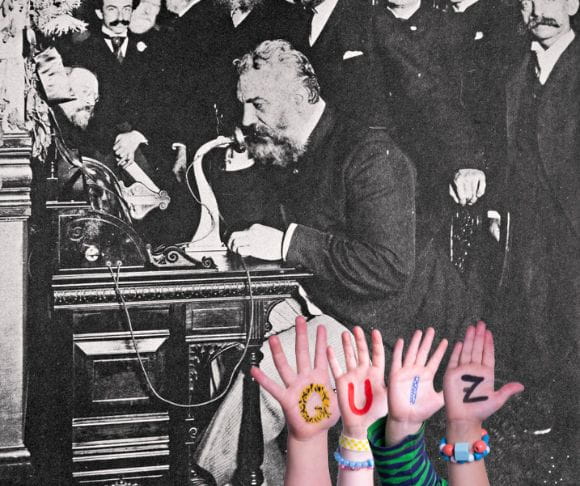
Alexander Graham Bell (Photo by Historica Graphica Collection/Heritage Images/Getty Images)
On March 10, 1876, Alexander Graham Bell placed the first telephone call to his assistant, Thomas Watson. His message was brief: “Mr. Watson, come here. I want to see you.” Though the words were somewhat distorted, Watson could still understand them, marking a historic breakthrough that changed the way people communicate forever.
Alexander Graham Bell’s Telephone
Alexander Graham Bell, who was born in Scotland, worked at the Clarke Institute for Deaf Mutes in Northampton, Massachusetts, in the late 19th century. At the time, the organization’s president was Gardiner Greene Hubbard, who – like Bell – had a keen interest in telegraphy, a long-distance communication method.
Hubbard decided to fund Bell’s research after the inventor designed a “harmonic telegraph,” which could “transmit several messages along the same wire by using tuned electromagnetic reeds to send and receive multiple pitches—or frequencies—simultaneously,” according to Science Museum.
Bell’s device improved early telegraphy, but he had something even more revolutionary in mind: holding entire conversations across long distances in real time. “If I can get a mechanism which will make a current of electricity vary in its intensity, as the air varies in density when a sound is passing through it, I can telegraph any sound, even the sound of speech,” Bell said.
 Bell eventually discovered a way to transmit “not only exact pitches, but more complex sounds,” which would serve as the foundation on which he would build a system to transmit speech. Following Hubbard’s advice, Bell filed for a patent on the principle of speech transmission, and on March 7, 1876, Bell was granted US patent number 174465A. Just three days later, Bell made his historic phone call to Mr. Watson.
Bell’s telephone required extensive improvements before it could be shown to the public, and roughly three months after the first phone call, the inventor showed his device at the Philadelphia Centennial Exhibition. Two months after that, Bell received the first one-way long-distance call, which connected Brantford to Paris, Ontario.
Hubbard later created the Bell Telephone Company to sell the device to the public. Bell served as the company’s technical adviser until the 1880s, after which the inventor sold his part of the lucrative company.
The Electric Bullet Probe
While Bell is best known for his work on the telephone, he was also behind another major invention: the metal detector.
In July 1881, President James Garfield was shot in the back by an assassin. Doctors couldn’t locate the bullet, so Bell attempted to find it using “an induction balance, a by-product of his research on canceling out electrical interference on telephone wires.” Basically, an induction balance would make a sound when it was near a metal object. Garfield died in September before Bell could locate the bullet. Still, the invention was praised by surgeons, who used it to save lives during World War I, according to Britannica.
Bell became an American citizen in 1882, but eventually he settled with his family in Nova Scotia, Canada, where he later died. He was buried at his estate in the Canadian province. Bell shared many wise thoughts throughout his life, including this famous quote: “When one door closes another door opens; but we so often look so long and so regretfully upon the closed door, that we do not see the ones which open for us.”

- Alexander Graham Bell invented the telephone.
- During the first phone call, Bell said to his assistant, “Mr. Watson, come here. I want to see you.”
- Bell also invented the first metal detector to help President James Garfield after he was shot by an assassin.