Thomas Edison: A Prolific American Inventor
Edison held over 1,000 patents.
By: Elizabeth Lawrence | May 11, 2026 | 579 Words
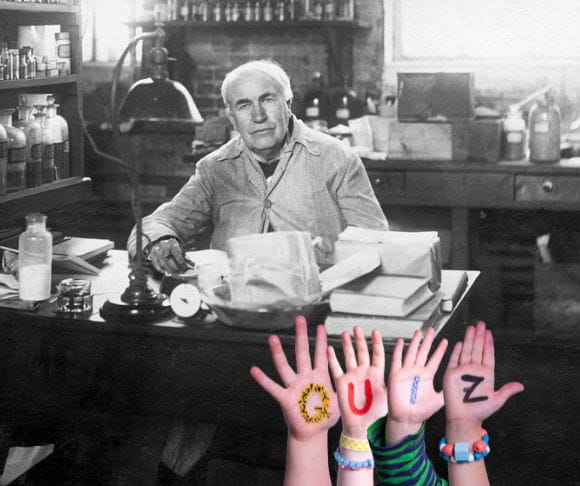
Thomas Edison (Photo credit: Getty Images)
Thomas Edison was one of the most prolific inventors in American history. Once the world-record holder of 1,093 patents, Edison invented creations ranging from the first practical incandescent light bulb to a motion picture camera. Before his death in 1931, Edison’s work helped to advance technology, improving life for people all over the United States and the world.
The Inventions of Thomas Edison
The lightbulb is widely considered Thomas Edison’s most famous invention, but his role in its creation is a bit complicated. Edison didn’t create the very first lightbulb, which was unreliable and expensive; rather, he invented the first lightbulb that was long-lasting, practical, and economical.
Edison made history once again with the phonograph, an invention that was used to record someone’s voice and play it back. According to the Edison Innovation Foundation: “The first recorded message was of Thomas Edison speaking ‘Mary had a little lamb’, which greatly delighted and surprised Edison and his staff when they first heard it played back to them.”
Edison also developed the Kinetograph, an early movie camera that used 35 mm celluloid film. At the inventor’s movie studio, nicknamed “The Black Maria,” the public was given the opportunity to view crude short movies on the device.
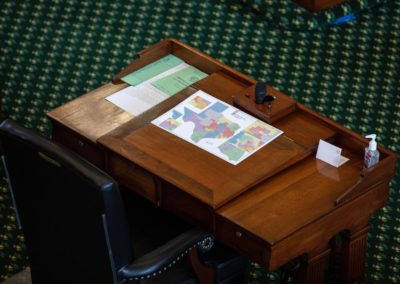
One of Edison’s lesser-known inventions is his electrographic vote recorder, for which he filed the patent at just 22-years-old. “The device was made with the goal of helping legislators in the US Congress record their votes in a quicker fashion than the voice vote system,” Edison Innovation Foundation explained.
Edison established research and design facilities in West Orange, New Jersey, where he “combined invention and entrepreneurial activities.” The inventor managed thirty companies and over 10,000 employees from his office in West Orange. His other famous inventions include the electric utility system and the alkaline family of batteries.
Edison’s Home Life
Edison was born on February 11, 1847, to parents Samuel Edison, Jr. and Nancy Elliot Edison in Weston Orange, New Jersey. He was one of seven children, his siblings being Marion Wallace, William Pitt, Harriet Ann, Carlie Snow, Samuel Ogden, and Eliza Smith.
 Before he became an inventor, Edison developed hearing difficulties, which were most likely caused by mastoiditis, according to Britannica, which stated that his deafness “strongly influenced his behaviour [sic] and career, providing the motivation for many of his inventions.”
Edison was known as imaginative and curious, but he struggled in school due to his hearing loss. While his formal schooling was limited, Edison loved to read, and after dropping out of school in 1859, he became an apprentice telegrapher.
Edison spent six years as an itinerant telegrapher before abandoning the career to become an inventor and entrepreneur. He moved to New York City and later married Mary Stilwell, with whom he had three children. Tragically, Stilwell died from what is believed to be either a brain tumor or an aneurysm at just 28-years-old. Edison eventually married Mina Miller and had three more children.
On October 18, 1931, Edison passed away in his home, which was then in West Orange, New Jersey. His final words – the perfect conclusion to a life defined by his positive impact on humanity – are widely believed to offer a glimpse into Heaven: “It’s very beautiful over there.”

- Thomas Edison invented the first lightbulb that was long-lasting, practical, and economical.
- The inventor also developed the Kinetograph, an early movie camera, and the phonograph, a voice recorder.
- When Edison died in 1931, his last words were: “It’s very beautiful over there.”