A Short History of the US Military: Sinking of the USS Maine
On a quiet day in the harbor at Havana, Cuba, a sudden explosion marked the beginning of the Spanish-American War.
By: Dave Patterson | July 29, 2025 | 769 Words
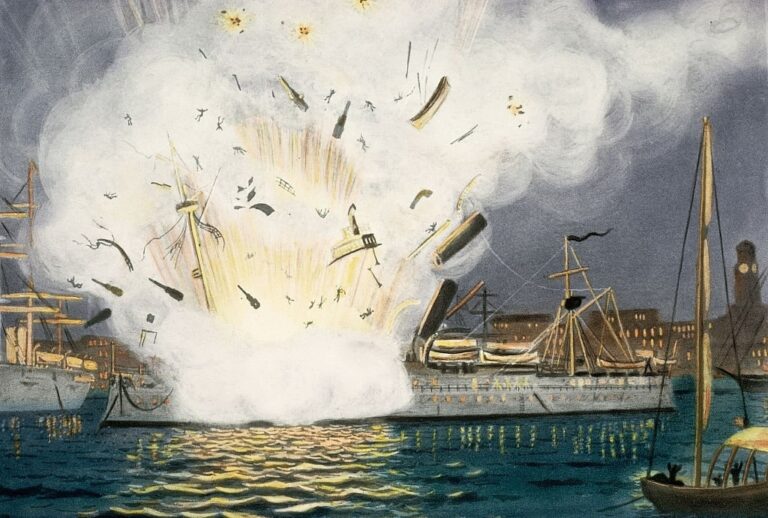
USS Maine (GettyImages)
As Liberty Nation GenZ: News for Kids continues its history of the US military, looking back on some of the key engagements is instructive – and the Spanish-American War doesn’t get the coverage that it deserves. Most people think of Teddy Roosevelt and his “Rough Riders” charging up San Juan Hill in Cuba, but don’t get much beyond that. The story of the Spanish-American War is intriguing, with numerous twists and turns, egos, and competing business interests at play. There had been growing tensions between Spain and the United States over what America perceived as the cruel treatment of Cubans who wanted independence from Spanish colonial rule. US President William McKinley was particularly angry about what he perceived as unprecedented brutality against the Cuban population by the Spanish. But none of that was quite enough to justify a war – not, that is, until the sinking of the USS Maine.
USS Maine at the Bottom of Havana Harbor
Tensions between the US and Spain peaked in early 1898 when President McKinley ordered the USS Maine to Havana Harbor, Cuba, as a show of force. The USS Maine arrived and anchored in Havana Harbor on January 25, 1898, and, by comparison with the other ships at anchor, presented an imposing visage. With this demonstration of sea power, many in Washington, DC, believed the Spanish could be cowed into withdrawing from Cuba. That was not to be. As the Maine gently pulled against its moorings at 9:40 p.m. local time, a horrendous explosion tore the mighty ship apart just aft of the bow at the forward 6-inch gun reserve ammunition magazine, according to a Naval War College Review article. The result was that the Maine sank in the harbor, and with the explosion, 266 of the 373 officers and enlisted seaman lost their lives.
Studies Suggest Accidental Explosion
 An examination of the incident by Admiral Hyman Rickover in 1977, summarized in the Naval War College Review, concluded that the most likely cause of the explosion was “a fire started by spontaneous combustion” that began in a coal bunker next to the magazine. “Such bunker fires were common in battleships of the time,” Rickover’s report asserted. Coal dust would hang in the air of the coal bunkers, often thick as fog, and it took little in the way of a spark to set the dust ablaze.
However, that was not the story that became popular. An official inquiry by the Navy, conducted shortly after the sinking, strongly suggested that there was a more malevolent cause for the explosion. The conclusion indicated that eye-witness testimony pointed to an external mine explosion as the cause. Furthermore, a 1911 effort by the US Army Corps of Engineers “built a cofferdam around the ship, pumped out the water, and exposed the wreckage,” a US Naval Institute (USNI) report explained. The USNI account went on to say:
“A Board of Inquiry based much of its analysis on photographs of physical evidence that the previous investigation had sensed but not seen: bottom plates that were bent inward, presumably by an external force, such as a mine. The board focused on a section of outside plating that ‘was displaced inward and aft and crumpled in numerous folds.’”
Who laid the mine? Fingers began pointing at Spain. It didn’t take much convincing once the two major daily newspapers, the New York Journal, owned by William Randolph Hurst, and Joseph Pulitzer’s New York World, with their “yellow journalism” style of sensationalizing any story, got hold of the Navy findings. There was no stopping the march to war with Spain.
A subsequent analysis by the National Geographic Society in 1998 relied heavily on computer modeling. It concluded that both the external mine and internal coal bunker fires were potentially at fault but leaned toward the accidental internal explosion in a coal bunker, which was exacerbated by design flaws. According to National Geographic, there was little conclusive evidence to determine what caused the explosion definitively. So, more than 12 decades later, the mystery surrounding the sinking of the USS Maine continues.

- Tensions were high between the US and Spain, and in 1898, the president sent the USS Maine to Havana, Cuba, where it eventually exploded and sank in the harbor.
- Modern investigations suggest the explosion was actually an accident that happened on the ship itself. Reports at the time, however, indicated it might have been a mine outside the ship. Biased journalists spread the idea that Spain had set the mine.
- With public opinion already against Spain and the spread of the claim that the Spanish had blown up the USS Maine, going to war became inevitable.
Test Your Knowledge – Take the Quiz