Why the Whole World Is Watching the Strait of Hormuz
Tensions are high as Iran attempts to bottle up shipping through the waterway.
By: Dave Patterson | March 25, 2026 | 766 Words
(Photo by Jonathan Raa/NurPhoto via Getty Images)
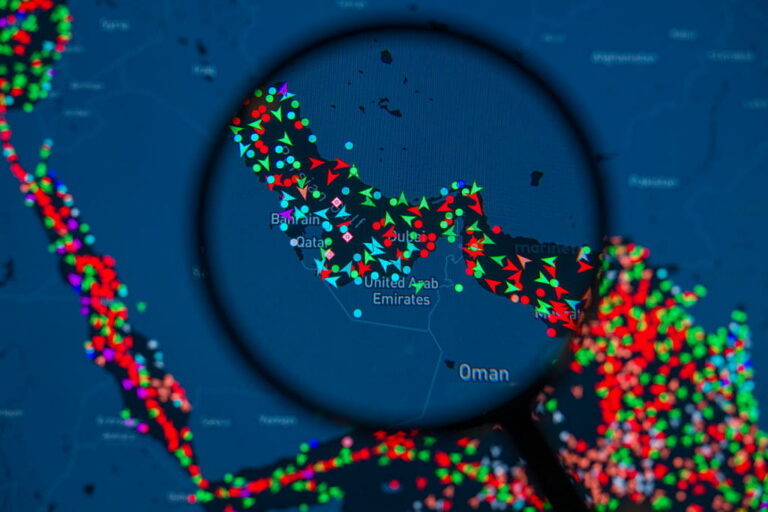
The Strait of Hormuz is a waterway that connects the Arabian Gulf and the Gulf of Oman. It is bordered to the south and west by the United Arab Emirates and to the north by Iran. At its narrowest, the strait is 24 statute miles wide and 104 miles long, and its significance cannot be overstated. Twenty percent of the world’s oil transits through the narrow passage. Because the United States and Israel are at war with Iran, the government in Tehran has closed the strait, threatening ships that attempt to cross with anti-ship missiles, drones, and mines.
Strait of Hormuz Is Prominent in World History
The Hormuz Strait has a long history as a chokepoint for seafarers. According to History.com, Portuguese sailors reached the Arabian Gulf as early as 1507 “while sailing around Africa on the way to India. After capturing the small island of Hormuz, the Portuguese built a fortress and a customs house there to collect tolls from ships passing through the strait to trade in commodities like silk, spices, pearls, and Arabian horses.” The Portuguese enjoyed a lucrative business collecting tolls and kept their hold on the strait until they were displaced in 1622 by a partnership between Abbas the First, Shah of Persia, and the British East India Company. England’s formidable navy provided the security for valuable trading contracts with the Shah, making England a central player in the history of the Hormuz Strait for the next several centuries.
Then, in 1908, oil was discovered in Iran, elevating the importance of Persia, later Iran, forever. Since England had a major presence in the region, the British were dominant in exploiting the petroleum, establishing the Anglo-Persian Oil Company, which later became British Petroleum (BP). The Hormuz Strait became crucial to getting the oil to market. Following World War II, in 1951, Iranian Prime Minister Mohammad Mossadegh nationalized Iran’s oil industry, “which included the largest oil refinery in the world at the time at Abadan.” This did not sit well with the British, who responded by having the Royal Navy blockade the port of Abadan, keeping Iranian oil tankers from using the Strait of Hormuz. Eventually, Mossadegh was deposed, the British re-established BP, and the strait was reopened.
Fast forward to the 1980s, and during the Iran-Iraq war (1980 to 1988), Iran threatened numerous times to close the Strait of Hormuz. Tensions were high, and to protect shipping through the strait, the United States reflagged Kuwaiti oil tankers as American and deployed US warships to escort them through the strait. A major incident occurred during the escort missions when the USS Samuel B. Roberts was hit by an Iranian mine. As William Luti tells the story in The Wall Street Journal, “On April 14, 1988, the USS Samuel B. Roberts was hit by an Iranian mine while escorting Kuwaiti oil tankers in the Persian Gulf. The explosion lifted the ship out of the water, ripped a 30-foot hole below the waterline, destroyed a 15-foot section of the keel, and seriously injured 10 sailors.”
Iran Laid Mines and Lost Half Its Navy
In response, President Ronald Reagan directed the US Navy to engage the Iranian navy with combined surface-ship and air attacks in a day-long battle that destroyed half of Iran’s naval vessels. Luti explained that “we didn’t know the ensuing fight would become the largest naval and air battle since World War II … Iran never laid mines in the Gulf again.” That is, until now. Reports from the region indicate that Iran, in mid-March 2026, deployed anywhere between a dozen and a few dozen mines in the strait to disrupt the transit of ships through the waterway.
 Reuters explained, “Iran has long threatened to retaliate against any military attack by mining the strait … The US military says it has targeted Iranian mine-laying vessels, eliminating 16 of them on Tuesday [March 11].” In addition to those, the United States is also bombing mine storage facilities as well as Iran’s capability to produce new mines.
According to Business Today, “Iran has effectively shut the Strait of Hormuz, a key waterway for global oil and gas trade, and has only allowed Chinese vessels through, according to multiple reports. The closure has stranded many ships, with reports of around 20,000 seafarers remaining stuck in the Persian Gulf.” The United States and Israel are focusing on eliminating Iran’s capability to hold tankers and cargo ships at risk and reopening the Hormuz Strait. As in the past, the strait has become a critical piece of geography, playing an important role in geopolitics.
~
The views expressed are those of the author and not of any other affiliate.