US and Israel Conflict With Iran Has a Long History
This fight didn’t start with Operation Epic Fury.
By: Dave Patterson | March 16, 2026 | 1055 Words
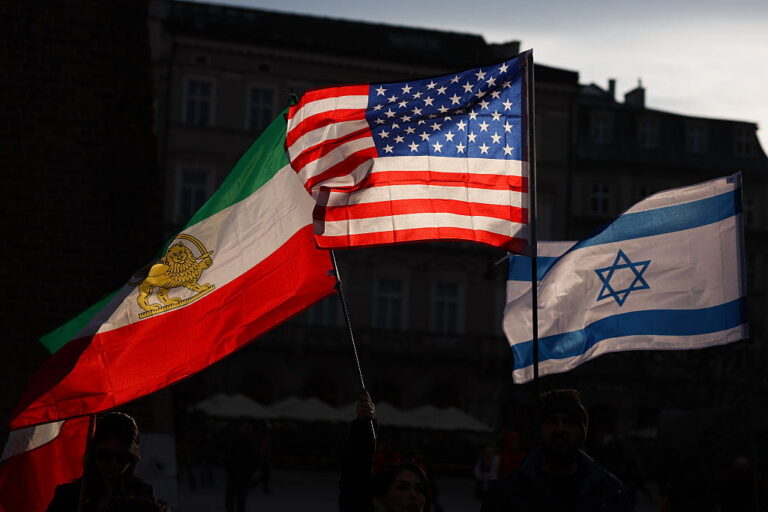
(Photo by Jakub Porzycki/NurPhoto via Getty Images)
The air war between the US, Israel, the Gulf States, and Iran rages on. However, the circumstances that have led to this regional conflict did not occur overnight. To understand how events led to the current situation in Iran, it’s worth looking at some modern history. After World War II, Soviet and British forces remained in Iran, competing for influence. Iran was very important as a source of oil. The US became involved, and Cold War tensions with the Soviet Union forced the Soviets to depart.
Iran Suffered From Political Unrest
According to a publication by the Grey Art Museum at New York University, during the post-war period, the status of the monarchy under the leadership of Mohammad Reza Pahlavi, Shah of Iran, underwent a resurgence. There was also, in the early 1950s, a growing nationalism, led by a prominent Iranian leader, Mohammad Mosaddegh, who formed the National Front Party. Mosaddegh, who was appointed prime minister, was intent on upholding the 1906 Constitution, which, among other things, limited the Monarchy’s power. More importantly, Mosaddegh set about nationalizing Iran’s oil industry. The importance of oil in Iran’s history can’t be overstated. What was the Anglo-Persian Oil Company, run by the British, became the National Iranian Oil Company run by Iranians. As you might expect, this did not sit well with the British. In 1953, the intelligence services of the United Kingdom (MI-6) and the United States (CIA) orchestrated a coup that toppled Mosaddegh’s leadership. The remainder of the 1950s was marked by political unrest and leadership turmoil.
The Grey Art Museum explained what happened after political circumstances inside Iran began to devolve:
“In 1963, the Shah announced his White Revolution, a program that included land reform, the nationalization of forests, the sale of state-owned enterprises to the private sector, a profit-sharing plan for industrial workers, and the formation of a Literacy Corps to eradicate illiteracy in rural areas. The White Revolution also granted Iranian women the right to vote, increased women’s minimum legal marriage age to 18, and improved women’s legal rights…”
These reforms had significant public appeal but were opposed by members of the Islamic Shia clergy, most notably the religious leader Ayatollah Ruhollah Khomeini. Students at a religious seminary went to the streets in the city of Qum in opposition to the White Revolution. The uprising was put down forcefully, with some students being killed. Because of his outspoken opposition to the White Revolution, Khomeini went into exile in 1964, first to Iraq and then to France. However, he continued to be a voice against the Shah and the Monarchy by making anti-Shah audio cassette tapes, which were widely distributed to dissidents in Iran.
Throughout the early and mid-1970s, Iran benefited from the oil money rolling in, enabling the Shah’s regime to embark on major infrastructure development programs. Additionally, the growing oil economy resulted in enormous military spending. Despite the good economic times, Islamic religious clerics were upset by the reforms, and then there was Ayatollah Khomeini stirring up trouble from afar, criticizing the Shah’s reforms as “un-Islamic and pro-American.” Furthermore, many believed the wealth coming in was unequally distributed, and many urban poor were suffering. Street protests in Tehran and other major cities became more frequent and violent. History.com reported, “Throughout 1978, a repeating cycle of protests, violent crackdowns, and new protests shook the Shah’s hold on power: January in Qom, February in Tabriz, March and May in dozens of cities, including Tehran. The opposition movements were diverse, ranging from leftists to pro-democracy centrists to Islamists like Khomeini’s movement.”
The Shaw Seeks Asylum
Opposition to the Shah became so intense that he took the US President Jimmy Carter’s offer of asylum and fled Tehran for America on January 16, 1979. On February 1, Ayatollah Khomeini returned triumphantly to Iran, establishing a theocratic Islamic Republic, changing Iran from a secular monarchy to a religious dictatorship where the Supreme Leader has ultimate religious and political power and authority. The new government suppressed any and all opposition, nationalized industries (including oil), and enforced Islamic laws, which were particularly oppressive for Iranian women. In November 1979, radical students seized the US Embassy in Tehran along with 52 diplomats and staff, holding them hostage for 444 days. This began the hostile standoff between the West, particularly the US, and Iran. The Iranian leadership identified the US as the “Great Satan,” and Israel as the “little Satan.”
 Fearing a spillover of the Shia uprising into Iraq, the Iraqis invaded Iran and began what turned out to be an eight-year war that left over a million soldiers dead. Khomeini died in 1989, and for a while, there was a glimmer of the softening of Iran’s belligerence toward the West and its neighbors. However, hardliners in the theocracy prevailed, and Iran continued as the number one sponsor of global terrorism. Through its proxies like Hezbollah, Hamas, and the Yemeni Houthi terrorists, Iran perpetuated what became 47 years of conflict with the US and Israel predominantly, but the Western world as well. Furthermore, Iran has for decades pursued developing atomic weapons. Fueled by an underlying radical Islamic fundamentalism that was incompatible with Western culture and values, it was simply a matter of time before Iran would be in a major conflict with the West, Israel, and its neighbors.
America, along with Israel, has now set about an air campaign to change the geopolitical standoff that prevailed for nearly a half-century and end the threat Iran poses. The current air war over Iran is designed to eliminate Iran’s ballistic missiles and capability to build such weapons, stop its development of nuclear weapons, and halt the use of proxies to terrorize its neighbors and US forces in the region. No one could have anticipated in the 1950s what would be taking place currently. Looking back, however, the stepping stones were present leading to where the US, Israel, the Gulf States, and Iran find themselves today.

- The US, Israel, and several Gulf States are in open conflict with Iran now, but this isn’t as new as it may seem.
- The current style of government in Iran took power in 1979, and it has viewed America and Israel as enemies ever since.
- Oil has long been the basis of Iran’s economy, and it has been a driving factor in the country’s history.