The Civil Rights Movement – Equality for All
From slavery to segregation.
By: Elizabeth Lawrence | August 14, 2026 | 1012 Words
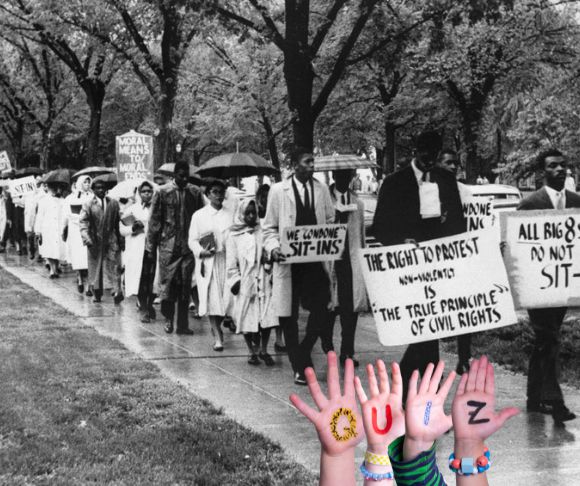
(Photo by Bettmann Archive/Getty Images)
In the United States of America, all are equal under the law. Well, all are equal under the law now – but that has not always been the case. From the early colonial days through the deadliest war the US ever fought and for a century after, America was plagued by racial oppression and legal discrimination. As people continued to fight to ensure that equality for all included black Americans, the Civil Rights movement was born.
Civil War and Jim Crow
It’s easy to look at US history and how quickly the nation rose from nothing and miss one critical fact: Much of colonial America was built by slaves. That said, many of the original states banned slavery shortly after the Revolution. Vermont was the first, stating in its 1777 state constitution that no man 21 or older or woman 18 or over could be held as a slave, servant, or apprentice without their consent. Pennsylvania’s legislation started phasing out slavery in 1780. Massachusetts and New Hampshire followed suit in 1783, and Connecticut and Rhode Island joined them in 1784.
Not all states and territories, however, would be free. The decades to follow saw tensions grow between free and slave states until finally, in 1861, the Civil War broke out. The Union (USA) the Confederate States of America (CSA) fought until 1865 – and in that time, more Americans died from combat and disease than in World War I, World War II, Vietnam, and the Korean War combined.
Following the Civil War, a period called Reconstruction began. During this time, the 13th, 14th, and 15th Amendments were passed and ratified. This ended slavery, granted the former slaves citizenship, and gave black males the right to vote, respectively. Black people were holding leadership positions and filling public office positions as well as seeking legal changes that would further benefit their rights as US citizens. Still, many in the Southern states did not adapt to the changes brought about by the abolition of slavery and the changes in legislation.
To fight back against the newly formed laws, they started requiring that blacks pay poll taxes and take literacy tests before earning the right to vote. In the late 19th century, the marginalization of black Americans continued with the establishment of Jim Crow laws. These disallowed them from using the same public facilities and schools as whites and made interracial marriages illegal. The Northern states did not adopt the same laws, though it was still difficult in some places for blacks to receive equal treatment.
FDR, World War II, and Changing Civil Rights
 The US Supreme Court derailed the efforts for equality by ruling in 1896 in Plessy v. Ferguson that segregated facilities would remain separate but equal. This separation of races, unfair wages, and the limitations on blacks who joined the military continued until the early 1940s, when a large group of black people threatened to march on Washington to demand equal employment rights and treatment in the US military. This got the attention of President Franklin D. Roosevelt, who issued an executive order on June 25, 1941, that opened thousands of government jobs to people regardless of their race, creed, color, or natural origin.
World War II began in 1939, and the United States joined the battle in 1941. Thousands of black men fought honorably and heroically for their country, despite the limitations on and segregation of black military personnel during the war.
It wasn’t until 1948 that an executive order issued by President Harry S. Truman ended discrimination in the military. Many see this as the beginning of the Civil Rights movement in earnest.
Making Headway in the Civil Rights Movement
Over the next decade or so, several efforts to eliminate racism took place. In 1955, Rosa Parks, a 42-year-old black woman, refused to give up her seat on a public bus in Montgomery, Alabama. She was arrested for her behavior, but news spread and people took notice of the events that day. Black leaders in the state formed the Montgomery Improvement Association (MIA), led by Martin Luther King Jr. He and the MIA incited a boycott of the bus system in Montgomery that lasted 381 days, and on November 14, 1956, the US Supreme Court found that Parks’ arrest and segregated seating were unconstitutional.
In its 1954 Brown v. Board of Education ruling, the Supreme Court declared segregation of public schools illegal. A few years later, a group of black students was invited to attend classes at Central High School in Little Rock, Arkansas. The Little Rock Nine were met by an angry mob and the National Guard blocking their entrance into the school. They tried again a couple of weeks later but had to be escorted out when the violence threatened their safety. President Dwight D. Eisenhower intervened and ordered federal troops to escort the students from class to class. This proved to be successful, though it didn’t stop the harassment the group faced.
A major step in the right direction took place in 1957, when Eisenhower continued his efforts to end racial discrimination by signing into law the Civil Rights Act.
The Assassinations of Malcom X and Martin Luther King Jr.
The law hardly ended the conflict, though. For the next decade or so, civil rights activists continued to protest and mount legal challenges. But after years of fighting racism, two of the civil rights movement’s leaders were killed. Malcom X, the founder of the Organization of Afro-American Unity, was assassinated at a rally on February 21, 1965. A few years later, on April 4, 1968, civil rights leader and a recipient of the Nobel Peace Prize, Martin Luther King Jr., was murdered on his hotel room balcony. These events led to intense rioting and looting and compelled President Johnson to continue moving forward with civil rights legislation.
Days after King’s assassination, the Fair Housing Act was signed into law, preventing discrimination based on race, sex, national origin, and religion. This would be the last law to be enacted during the Civil Rights Movement.

- Ending slavery did not end racial discrimination.
- Organized and repeated protests produced major change during the Civil Rights Movement.
- The movement secured landmark legal protections.