Presidents’ Day and the Founding Fathers
What did the Founders think about the nation’s top political office?
By: Elizabeth Lawrence | February 16, 2026 | 712 Words
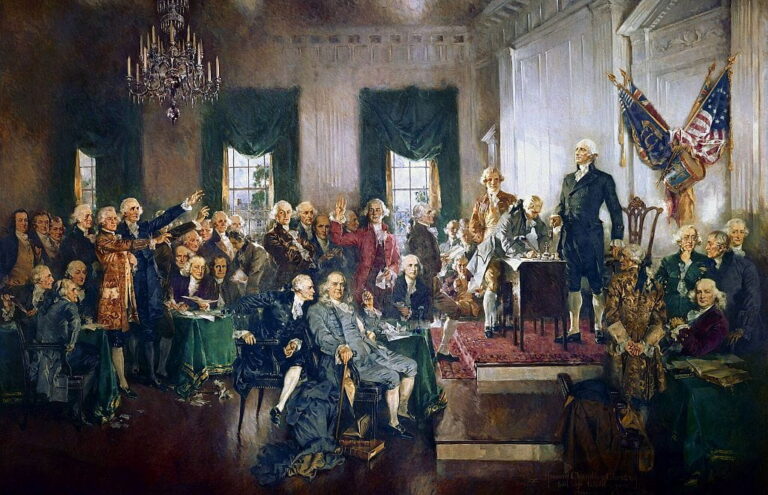
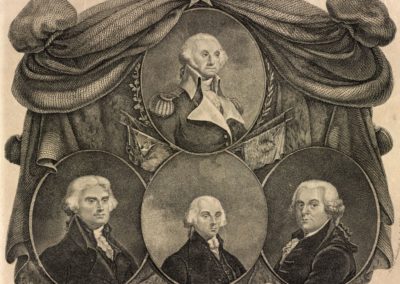
(Photo by: Universal History Archive/Universal Images Group via Getty Images)
Every year on the third Monday in February, Americans celebrate Presidents’ Day – an annual holiday acknowledging the office of the presidency. While the holiday was originally established to honor President George Washington’s birthday, it has since evolved to recognize all individuals who have been elected to the nation’s top political office.
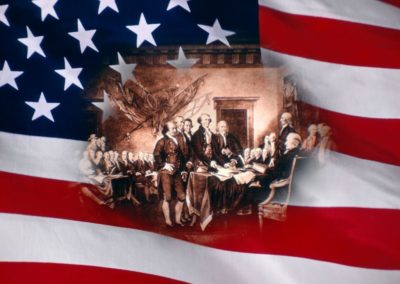
The first three presidents – George Washington, John Adams, and Thomas Jefferson – played critical roles in the founding of the United States. What did they think about the most powerful political office in the nation?
Presidents’ Day – George Washington and Foreign Influence
In 1896, a new tradition was born: Every year on George Washington’s birthday (February 22), a member of the United States Senate reads the first US president’s Farewell Address. After serving eight years in office, Washington warned about the dangers of foreign influence and corruption, through which the “policy and the will of one country are subjected to the policy and will of another”:
“Against the insidious wiles of foreign influence (I conjure you to believe me, fellow-citizens) the jealousy of a free people ought to be constantly awake, since history and experience prove that foreign influence is one of the most baneful foes of republican government.
“The great rule of conduct for us in regard to foreign nations is in extending our commercial relations, to have with them as little political connection as possible. So far as we have already formed engagements, let them be fulfilled with perfect good faith. Here let us stop.”
Even before modern technology changed global communication, Washington understood the impact foreign influence could have on the American people’s freedom. Presidents’ Day no longer follows Washington’s birthday, but that doesn’t make his insight any less relevant today.
President John Adams and Morality
The second president of the United States, John Adams, who also served as the nation’s first vice president, believed the American government required “morality and religion” to properly function. “Avarice, ambition, revenge or gallantry would break the strongest cords of our Constitution as a whale goes through a net,” Adams warned in a 1798 letter to the Massachusetts Militia. “Our Constitution is designed only for a moral and religious people. It is wholly inadequate for any other.”
Adams also expressed “dread” over the potential “division of the republic into two great parties, each arranged under its leader, and concerting measures in opposition to each other.” He considered such a development in American politics would be “the greatest political evil under our Constitution.” He further cautioned that a “Constitution of Government once changed from Freedom, can never be restored. Liberty, once lost, is lost forever.”
President Thomas Jefferson and Happiness
When Thomas Jefferson drafted the Declaration of Independence, he penned what would become one of the most famous lines ever written: “We hold these truths to be self-evident, that all men are created equal, that they are endowed by their Creator with certain unalienable Rights, that among these are Life, Liberty and the pursuit of Happiness.”
Thomas Jefferson regarded “happiness” as essential, enshrining it in our nation’s founding document alongside life and liberty. That conviction was carried into his presidency, and in 1802, one year after taking office, he wrote in a letter to Thomas Cooper that a quiet government is the mark of a happy society:
“[T]he path we have to pursue is so quiet, that we have nothing scarcely to propose to our legislature. a noiseless course, [not] medling with the affairs of others, unattractive of notice, is a mark that a society is going on in happiness. if we can but prevent the government from wasting the labours of the people, under the pretence of taking care of them, they must become happy.”
While the presidency has undoubtedly changed since George Washington was inaugurated on April 30, 1789, the Founding Fathers main concerns still echo in the Oval Office today. From foreign influence to morality and happiness, Presidents’ Day offers Americans an opportunity to consider whether the current state of the presidency reflects the Founding Father’s vision for the office.

- President George Washington warned about foreign influence in his Farewell Address.
- President John Adams highlighted the importance of morality in maintaining the US Constitution.
- President Thomas Jefferson believed happiness was as essential as life and liberty.