Montezuma Castle – America’s Most Famous Cliffside Fortress
A marvel of ancient architecture.
By: James Fite | August 25, 2026 | 564 Words
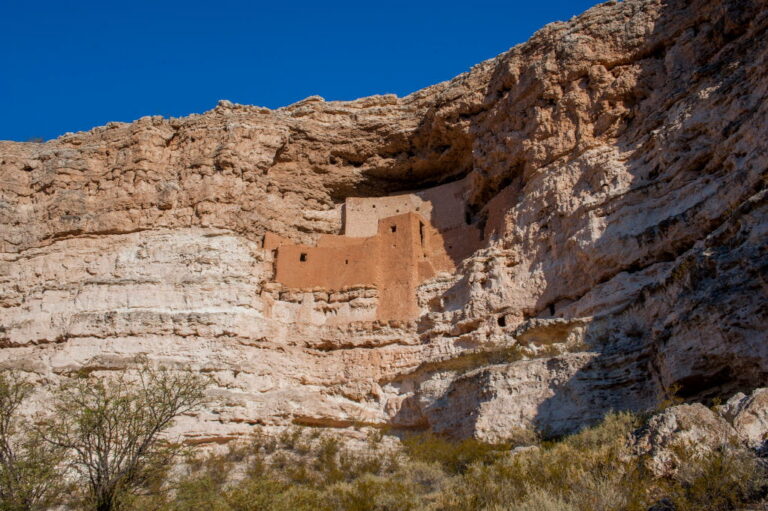
(Photo by Wolfgang Kaehler/LightRocket via Getty Images)
Consider the modern apartment complex. Many different families live in a variety of residential units in one much larger structure. Believe it or not, that is far from a modern concept. Long before Europeans ever arrived on the North American continent, indigenous peoples lived in cliff dwellings that resembled an apartment building of today. Perhaps the most famous of these is Montezuma Castle in Arizona.
Montezuma Castle – A Monumental Mistake of a Name
Around 1100, a culture later named the Sinagua – Spanish for “without water” – settled in what is today the Verde Valley in central Arizona. But rather than building their homes on the valley floor, which flooded annually thanks to nearby Beaver Creek, these people looked to the tall cliff faces nearby.
Between 1100 and 1350, the Sinagua build a five-story, 20-room village resting 90 feet up a vertical limestone wall. The alcove – which they walled in – provided shelter from desert heat, torrential rains, and even enemy attacks.
What does this have to do with the Aztec emperor, Montezuma II? The short answer is nothing. Montezuma wasn’t born until 1466, and his empire flourished a thousand miles to the south. In fact, by the time Montezuma rose to power, the Sinagua had already abandoned the site.
Enter early American settlers and soldiers, who rediscovered the ruins in the 1860s. They assumed such a grand structure must have been built by the Aztecs and named it Montezuma Castle. They were off by more than a century and a thousand miles – but the name stuck.
A Stunning Show of Ancient Ingenuity
If you’ve ever watched videos of any tall building – apartment complex or otherwise – being built, you know it’s a complicated process. Now imagine building this 20-room site nearly 100 feet in the air embedded in a cliff without modern machinery.
The Sinagua carried limestone blocks and mud mortar up ladders to construct stonework walls tightly to the natural curves of the cliff. For their timber ceilings, sycamore and juniper logs were hauled up from the creek bed below – and many of those timbers remain today.
Those stone walls and retractable wooden ladders provided security. If an enemy approached, the residents simply pulled up the ladders, making their “castle” impossible to enter.
Despite their cliffside homes, the Sinagua were also masters of agriculture. They engineered complex irrigation networks from Beaver Creek to grow corn, beans, squash, and cotton. But they didn’t stay. By the early 1400s, after about three centuries of residence, the Sinagua left the Verde Valley. No one is sure why, but archaeologists believe it was a mix of a long drought, depletion of resources, and conflicts with other people in the region. The Sinagua are believed to have integrated into various Hopi, Zuni, and Yavapai communities.
Modern Preservation
In the 19th century, looters and souvenir hunters caused a lot of damage by digging into the rooms. Realizing this was an immediate threat to ancient American history, President Theodore Roosevelt signed the Antiquities Act of 1906. Then, on Dec. 8, 1906, he declared Montezuma Castle to be one of the nation’s first four national monuments, alongside Devils Tower in Wyoming, El Morro in New Mexico, and Montezuma Well in Arizona. Today, visitors can no longer climb inside the ruins – they’re simply too fragile. But each year, hundreds of thousands stand below the limestone cliffs and marvel at the architectural genius of the Southwest’s early inhabitants.