Assassination – America’s Dark Tradition of Silencing Voices
Charlie Kirk joins a tragic brotherhood of assassinated Americans.
By: Elizabeth Lawrence | September 12, 2025 | 597 Words
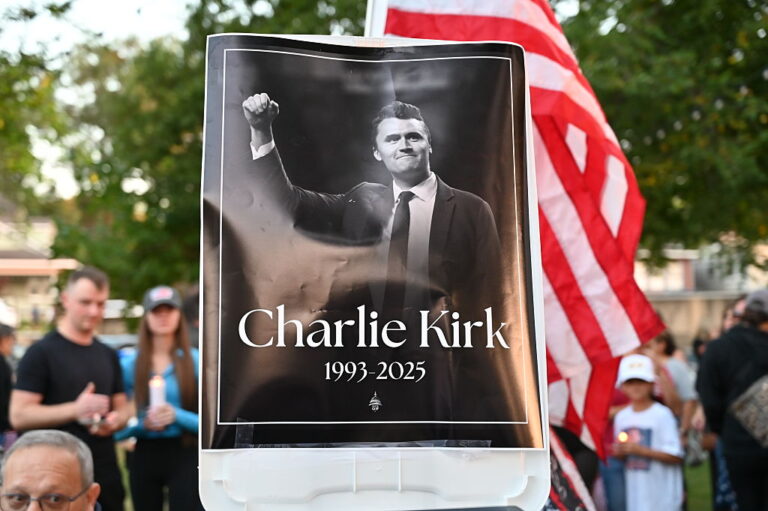
(Photo by Jacek Boczarski/Anadolu via Getty Images)
Conservative Christian activist Charlie Kirk, founder of Turning Point USA, was assassinated on Wednesday, September 10, while speaking at a college in Utah. The husband and father of two was fatally shot in broad daylight, a chilling reminder of one of America’s darkest traditions: the assassination of those who dare to stand up for what they believe in.
Assassination in America
Kirk is not the first innocent American to be gunned down for passionately defending his beliefs in the public square. Political violence in the United States has claimed the lives of journalists, religious leaders, and activists. One of the most well-known is Dr. Martin Luther King Jr.
Like Kirk, King was not a politician; he was a minister and activist who helped lead the American Civil Rights Movement until his assassination in 1968. His influence on the cultural and political battlefield was undeniable, making him a target of those who held opposing beliefs.
To secure voting rights and dismantle segregation, King led multiple successful protests, including the Montgomery Bus Boycott and the Selma Marches. His “I Have a Dream” speech is one of the most well-known speeches in American history.
Tragically, King was fatally shot on April 4, 1968, while standing on the balcony of his hotel room in Memphis, Tennessee. The news of King’s assassination spread like wildfire, sparking widespread riots that led to the deaths of 40 more people.
Before his assassination, King was asked how he wanted to be remembered after he died: “I’d like somebody to mention that day that Martin Luther King, Jr., tried to give his life serving others.”
In a strikingly similar way, Kirk was also asked how he would like to be remembered after his death: “I want to be remembered for courage for my faith. That would be the most important thing. The most important thing is my faith.”
 Like both Kirk and King, Rev. George Lee, a Baptist minister, was gunned down for standing up for what he believed in. Before his death on May 7, 1955, Lee became one of the first black Americans to register to vote in Humphreys County, Mississippi. He used his position as a minister to encourage other black people to register to vote, leading to threats against his life.
After urging black Americans to “pray you can make it through this hell,” Lee was shot by an unidentified assassin. The attacker fired a shotgun three times at Lee, shattering his jaw. He died before reaching the hospital. More than 1,000 people attended Lee’s funeral, but no one was ever prosecuted for killing him.
About 20 years later, journalist Don Bolles was assassinated while investigating organized crime and government corruption in Arizona. Unlike Kirk, King, and Lee, Bolles was killed by a car bomb. His death triggered the “Arizona Project,” which involved dozens of journalists vowing to complete Bolles’ work.
Silencing Voices
The assassinations of Kirk, King, Lee, and Bolles highlight the uncomfortable reality of political violence in America: It can happen to anyone who dares to speak out.
If the goal of assassinations is silencing voices, history has proven they are ineffective. The voices of King, Lee, and Bolles continue to inspire millions of Americans. Kirk’s voice will undoubtedly do the same. Ideas, once spoken, cannot be erased with a bullet.

- Charlie Kirk was the latest victim of political assassination, but he was not the first.
- Martin Luther King Jr., one of the most famous examples of assassination victims, was killed for his beliefs on equality.
- Assassins hope to kill their victims’ ideas along with them, but as history shows, the ideas live on.