An Other Worldly First Lady: Mary Todd Lincoln
By today’s unattainable standards, Mary Todd in the 1860s held her own and would be seen through a more positive lens today.
By: Sarah Cowgill | September 1, 2026 | 902 Words
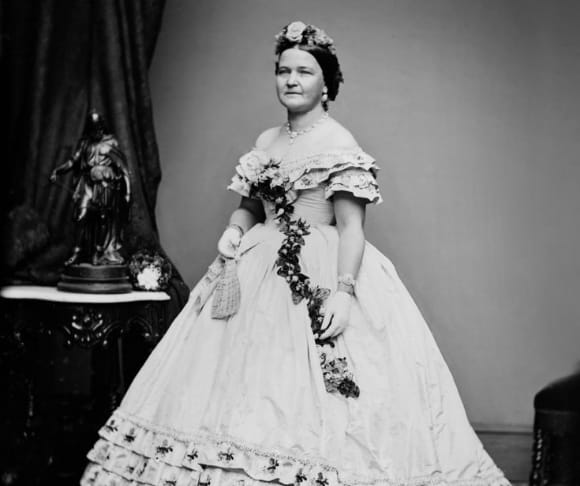
Mary Todd Lincoln (Photo by: Glasshouse Vintage/Universal History Archive/Universal Images Group via Getty Images)
First lady Mary Todd was scrutinized against former presidential wives and, at times, fell short in the eyes of the media for being a “country bumpkin.” Abraham Lincoln’s wife was attacked routinely by the Eastern press and elite Washington society for being “awfully western, loud, and unrefined.” She was mocked as a “rustic from the West” and called “coarse” and without manners because she was from Kentucky. The slurs could not be further from the truth. The Todd family was well-liked in Kentucky, and being ridiculed in the press was a horrible surprise.
Critics did not bother to report that Mary Todd Lincoln was sophisticated, highly educated, and well-versed in state and federal politics. Her upbringing in a prominent Kentucky family exposed her to both the nuances of social etiquette and the complexities of national and global affairs, preparing her for the challenges she would face in the White House as first lady. Yet she was hounded relentlessly by classism devotees and the regional bias of coastal elites unused to European-educated Southerners.
A Divided Family
As the Civil War divided the country, those same divisions echoed within her own family: While six Todd siblings supported the Union, eight Todd siblings supported the Confederacy through marriage or military service. Not surprisingly, divided loyalties in the Todd family fueled much controversy in the nation’s press. Family reunions at the White House did not happen.
What did happen is unprecedented: Mary Todd was the first first lady to welcome African American guests directly into the White House. Over the years, Mary had a close relationship with Elizabeth Keckley, an African dressmaker who had purchased her emancipation. Born into slavery, Keckley was offered freedom for $1,200. Since she was unable to keep her own earnings, this price was impossible. But she searched for ways to raise the money, and thanks to help from some of her wealthier clients, Keckley became a free woman on November 15, 1855, and set up her own dressmaking business.
It was no wonder Keckley caught the eye of another Washington woman who battled daily for acceptance.
Grief and an Otherworldly Outlet
During her time in the White House, nothing was more painful to Mary than losing her 11-year-old son, Willie, to typhoid fever. Mary turned to researching and joining the great spiritual awakening that was in its infancy in the US. The movement expanded rapidly during and after the Civil War, offering grieving survivors closure that the war had denied them. Through a network of followers of spiritualism, she was introduced to the Lauries, a well-known group of mediums that were located in Georgetown. Mrs. Lincoln found such comfort from the séances held by the group that she started hosting her own sessions in the Red Room of the White House. There is evidence to suggest that she hosted as many as eight ghostly events in the White House and that the president was even in attendance.
The séances proved to be such an effective coping mechanism for Mrs. Lincoln that she once remarked to her half-sister that “Willie lives. He comes to me every night and stands at the foot of the bed with the same sweet adorable smile that he always has had. He does not always come alone. Little Eddie [her son that perished at the age of four] is sometimes with him.”
Through spiritualism, Mrs. Lincoln, like many Americans at the time, found solace in the belief that one could communicate with lost loved ones. And the belief of the visitations was palpable to Mary Todd. After the assassination of her husband, President Lincoln, she commissioned a photograph that has a seated Mary and a ghostly Lincoln in the background.
Of course all Mary Todd’s actions to try and find peace backfired.
Debts, More Debts, and a First Lady Committed
The assassination of President Lincoln left Mary Todd Lincoln not only devastated emotionally but also in a precarious financial position. Without her husband’s income, she faced mounting debts from her years of lavish entertaining and personal expenditures, and public scrutiny over her spending intensified, forcing her to rely on the generosity of friends and eventually to sell personal possessions in an effort to regain some financial stability. At one humiliating moment, Mary Todd tried to sell her clothes.
Mary Todd moved with her son, Robert, to Chicago. But he began to believe his mother was losing her mind. He consulted with doctors and friends, and decided an asylum was where he would put his mother. At the time, Illinois law required a jury trial to determine insanity, so Robert took his mother to court in May 1875.
After a parade of witnesses who testified about Mary shopping excessively, seeming to have phantom pains, and obsessing about imagined dangers, a jury of twelve men ruled her insane and appointed Robert as conservator of her estate. It was a blow to Mary Todd, who did not know her son was behind her being institutionalized.
Tainted Lincoln Legacy
For the entirety of Mary Todd’s public life, she was treated without respect in the Nation’s capital. It is both unfair and sometimes outlandishly ridiculous.
But as first lady, Mary did just what all the others did before her: She held elegant buffet dinners, invited intellectuals and literary figures to the White House, and welcomed visitors and guests to her Thursday night receptions and spring and winter receptions.