Trump Accounts for Kids – What You Need to Know
The tax‑deferred investment accounts are available now.
By: Andrew Moran | July 17, 2026 | 736 Words
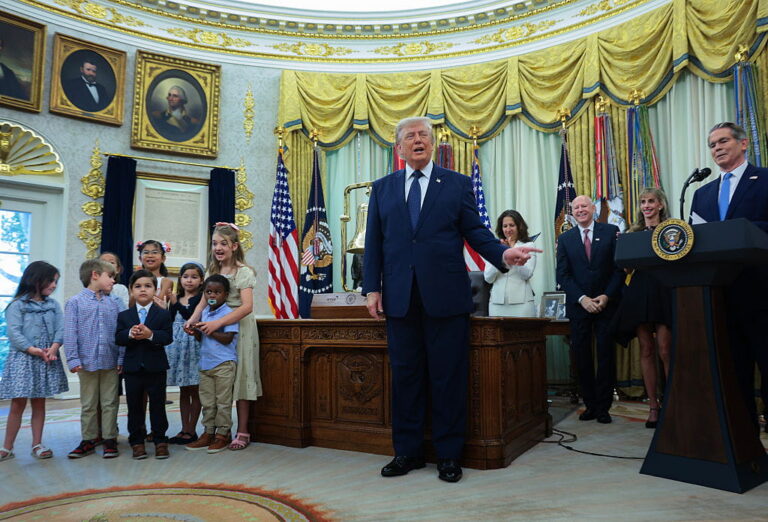
(Photo by Anna Moneymaker/Getty Images)
President Donald Trump rang the opening bells for the New York Stock Exchange and the Nasdaq from the White House on July 6 to celebrate the official launch of Trump Accounts, marking the first time both exchanges had a joint opening bell from the Oval Office.
Trump’s tax-deferred investment accounts – also known as the Trump Accounts – recently went live. The president’s landmark public policy initiative aims to give children born today an early advantage and offer more Americans the opportunity to participate in the US stock market. Early data suggest households are already signing up in vast numbers, signaling its popularity. So, what are these accounts?
Inside the Trump Accounts
Last year, the One Big Beautiful Bill created Trump Accounts (technically, 503A accounts), and the White House has been regularly touting the program.
Children born in the United States from 2025 through 2028 will begin their lives with a $1,000 seed deposit from the federal government, deposited into a dedicated investment account. Any child with a Social Security number can participate. Families are allowed to add up to $5,000 in after‑tax savings each year, and employers can chip in $2,500 pretax for their workers’ children.
To start, parents or guardians can complete IRS Form 4547 on TrumpAccounts.gov or download a mobile application from any US app store and fill in the information.
Until the child reaches adulthood, the balance is locked into low‑cost index funds tracking the US stock market to build long‑term growth. Beneficiaries can then use the funds to pay for tuition, buy a home, or start a business. But there are certain ages to monitor.
 After turning 18, half the balance can be withdrawn for qualified uses (non-qualified uses are taxed as ordinary income). At age 25, you can access the full balance for qualified purposes. Finally, at age 31, the account must be terminated, and the remaining funds can be withdrawn for any reason and will be subject to long-term capital gains tax.
Prior to its debut, the White House Council of Economic Advisers crunched the numbers to determine how much these accounts could be worth under various scenarios.
Assuming no additional contributions and using average stock market performance estimates, Trump Accounts could grow to almost $6,000 by the time a child turns 18. Based on maximum contributions and average market conditions, these accounts could balloon to as much as $300,000.
Approximately 6 million families have already signed up, according to the Social Security Administration.
Expansion Plans
Even before its official launch, Trump Accounts have been expanded to include even more young Americans.
Tech billionaire Michael Dell and his wife, Susan, have committed $6.25 billion to support children who missed out on the federal $1,000 contribution. Their plan provides a $250 contribution for kids born between 2016 and 2024, targeting families in ZIP codes with a median income of $150,000 or less.
An increasing number of US companies and philanthropists have pledged to match the government’s $1,000 contribution for their employees.
Micron Technology, for example, was the latest firm to announce a $250 million investment in Trump Accounts. It will match employee contributions up to $1,000 per child under 18 and provide a one-time $250 seed deposit for eligible children in the states where the chipmaker operates, such as California and New York.
The administration also announced in June that children in foster care will have access to these savings and investment accounts.
State, territorial, and tribal child‑welfare agencies will be granted the authority to act as guardians for children in foster care solely to open and administer these investment accounts. For eligible children who receive Supplemental Security Income due to a disability or federal survivor benefits, the state may transfer those payments directly into a Trump Account.
“For the first time, children in foster care will have access to a dedicated savings and investment vehicle: Fostering the Future Accounts,” First Lady Melania Trump said in a statement.
“Fostering the Future Accounts give foster children the same chance for asset ownership and long-term wealth building as every other American child. By investing in our foster youth now, we help strengthen America’s workforce, communities, and economic future.”
We’re in the Money
For many households struggling to fund their children’s futures, this $1,000 deposit can ease the financial strain on moms and dads across the country. It also gives even more Americans the chance to become passive investors on Wall Street. In an economy where owning assets is key to surviving and thriving, Trump Accounts can check many boxes.